
By Meg Pantry, Third Year, Law
Where there's FOMO, there's moneymaking potential. And so, as each September sees Bristol taken over by a throng of new students anxious to make the most of the ever mythologised Freshers' week, there's no shortage of opportunities for marketing strategies to exploit their fears. Meg Pantry investigates the money making schemes that are taking over Freshers' Week.
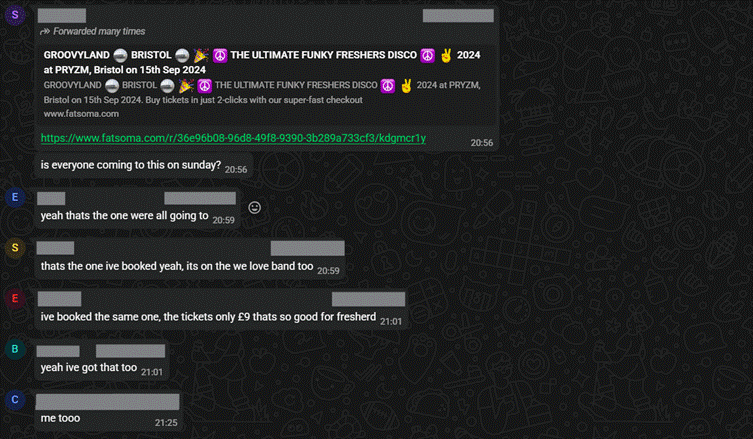
The phenomenon of exploiting students FOMO is initially most noticeable in fresher's group chats which, though ostensibly created with the intention of giving prospective students the opportunity to connect with each other prior to arriving at university, may be more insidious than meets the eye. Although the groups are undoubtedly useful in fostering communication between students, it quickly becomes apparent that each is inundated with links to events, invariably accompanied by a question along the lines of ‘This is the event that everyone bought a ticket to, right?’ And, like clockwork, a barrage of responses follow: ‘Yeah, i did, then i added on the queue jump’; ‘I think literally everyone has so those should be gooddd’; ‘me too, it's on sale right now as well so its cheaper’.
A little digging reveals a shocking truth about what appears to be harmless conversations between students. It's all staged. The accounts do not participate in any conversation in the group chats other than talking to the same people, time and time again, about a given event; how its almost sold out, how everyone is going, how everyone is buying the add-ons.
The majority of accounts proselytising about these events are administrators and creators of the group chats that the conversations are taking place on.
This suggests that fear mongering club promoters are not an unwelcome side effect of freshers' group chats created with good intentions, rather that the group chats are often created for the sole purpose of misleading freshers into buying tickets.
So, what's the impact of this eagerness to sell club tickets at all costs? Strangely, it's not entirely negative. In spite of the fact that freshers' group chats are, most often, created with the intention of profiting off of students' FOMO, they remain genuinely useful tools that allow students to get to know their course mates and flatmates prior to arriving at university.
However, the culture of commercialisation does produce a myriad of negative effects. For many, Freshers' Week is already an overwhelming experience, as students find themselves tasked with adapting to a new city, new people, and a new way of life. By targeting freshers' fears of being left out, these club promoters only compound the amount of stress put on new students.
A survey conducted by Epigram revealed that 82 per cent of respondents felt pressure and/or FOMO as a result of these promotional strategies.
Although only 18 per cent of students reported actually buying an unofficial wristband or freshers' event ticket, those who did were generally critical of the experience with only 10 per cent of buyers describing the experience as ‘largely positive’. One student commented: ‘They're not that good, so you end up disappointed whether you go or stay at home and experience FOMO’, while another lamented that it is ‘disappointing that so many of the freshers group chats were run by these companies’.

Interestingly, it is also possible that this kind of marketing contributes to a changing perception of Fresher's Week as revolving around nightlife. This isn't to say that clubbing hasn't always been a significant part of the student experience, but that the ubiquity of FOMO-based club advertising may give students the impression that going out every night is the sole function of Freshers' Week. This results in a plethora of potential consequences for students. For one, clubbing is not for everyone, and so the expectation that Freshers' week must be a week of non-stop partying risks ostracising students who prefer not to engage in nightlife, for example, neurodivergent students overwhelmed by clubs, students who do not drink, and students who simply do not enjoy the experience.
Although clubbing does not require drinking alcohol, it is no secret that the two often go hand-in-hand, and studies show that heightened levels of drinking during Freshers' Week can lead to heightened alcohol use in general. Therefore, there is certainly a possibility that the club-centric image of Freshers' week being promoted could lead to more students developing problematic relationships with alcohol. In addition to these more speculative consequences, there is also the obvious - going out every night is expensive.
It is worth acknowledging, however, that this club-centric image of Freshers' week may not be entirely bad. The Gen Z Screen Time Report 2026 found that Gen Z spends an average of 7 hours and 43 minutes on screens per day, with this number only increasing. The impact of this is reflected in the unprecedented rates of loneliness and mental health issues reported amongst Gen Z. Overall, the impression given by statistics is of a generation plagued by self-isolation, and feeling the consequences. So, it is certainly possible that pressure to get out and socialise, however ill-intentioned, might have some benefit. What is important, though, is that freshers keep in mind that there is no 'right' way to spend freshers' week, and resist the pressure from bad actors that seek to profit from their FOMO.
 Meg Stannett
 Jessie Dutton
Featured Image: Epigram / Meg Pantry
Did you buy a Freshers' Week wristband?