By Lenny Osler, News Reporter
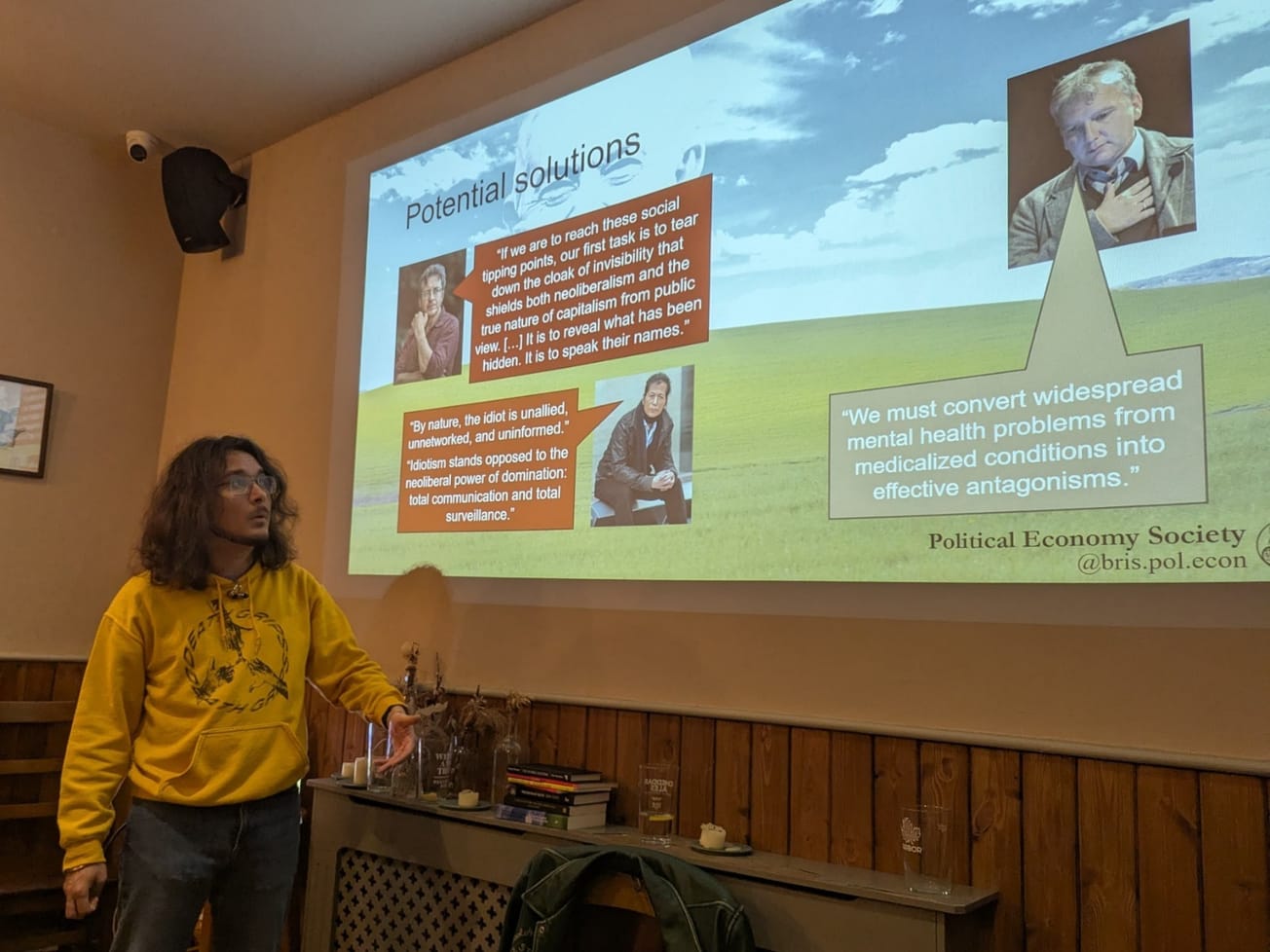
In March, I interviewed Louis Bush, a second-year student of Politics and Economics, to discuss his journey creating and leading a brand-new society that takes a slightly different approach to the study of economics. Through Political Economy Society (PolEconSoc), Louis aims to create an accessible and welcoming space for students interested in the political and sociological aspects of economics. The society is free to join and offers unmissable speaker events to members.
PolEconSoc aims to connect economics to everyday life, rather than presenting it as just a series of maths equations. And, crucially, to demonstrate why politics, and power relations, are the real drivers of economic outcomes. I sat down with Louis to talk about the birth of Political Economy Society (PolEconSoc), its impact and significance, and his plans to grow the society in 2026/27.
What sparked the idea of founding PolEconSoc?
‘Well first of all, around this time last year I was looking at EFM (Economics, Finance and Management) Society, and their events were all socials. But they were posited as the official academic society for the School of Economics, and I found that super weird.’
‘In PhilSoc (Philosophy Society), you have this amazing environment where people effectively lead seminars and tutorials on topics in philosophy. Like, why can’t we have that?’
‘And second, I was speaking with Dr Danielle Guizzo in the School of Economics, and what she teaches is more heterodox. It’s beyond the scope of the kind of ‘textbook’ economics that’s generally taught at Bristol and at most universities. And I was like wow, this is really interesting, I wish we were doing this more on our course.’
"Discussing the economy, we must acknowledge the variety of demographics, functions, jobs, and identities of those living within it."
Why is the existence of PolEconSoc particularly important right now?
Within how economics is being taught, there’s this huge emphasis on solving mathematical problems. Whether people are rich or poor, whether people's needs are met, it’s just treated like a numbers game. Like you can solve that in the same way that you can determine the optimal construction of a bridge.
But the economy is not a bridge. When you do stuff in maths, there's an objectively correct solution. But discussing the economy, we must acknowledge the variety of demographics, functions, jobs, and identities of those living within it.
It then becomes more of a political discussion: there are different people, they want different things, we are stakeholders. If we reduce all of these things to just conversations about maths, we totally remove the concept of value from these things.
Moving on to the highlights of the last year, which guest speakers have you brought in for PolEconSoc events?
I think the talk by Jo Michell was really good. He’s an academic from UWE, and chair of the Post-Keynesian Economics Society. We had a student attending who was into right-wing, free market economics. So there was this dialogue, a debate, between an academic who was very educated on the subject and a student who would never have been able to have that conversation outside of PolEconSoc.
These are the sort of things you would imagine happening in an idealised seminar.
Have there been any challenges involved with setting up a new society?
We weren’t eligible for booths at the Welcome Fair, so immediately we were screwed because that’s hundreds of students that we’re unable to advertise to. We didn’t have the reach we were really hoping for, so we ended up relying on postering, word of mouth, and advertisement through existing societies’ Instagrams.
How have you engaged students over the past academic year?
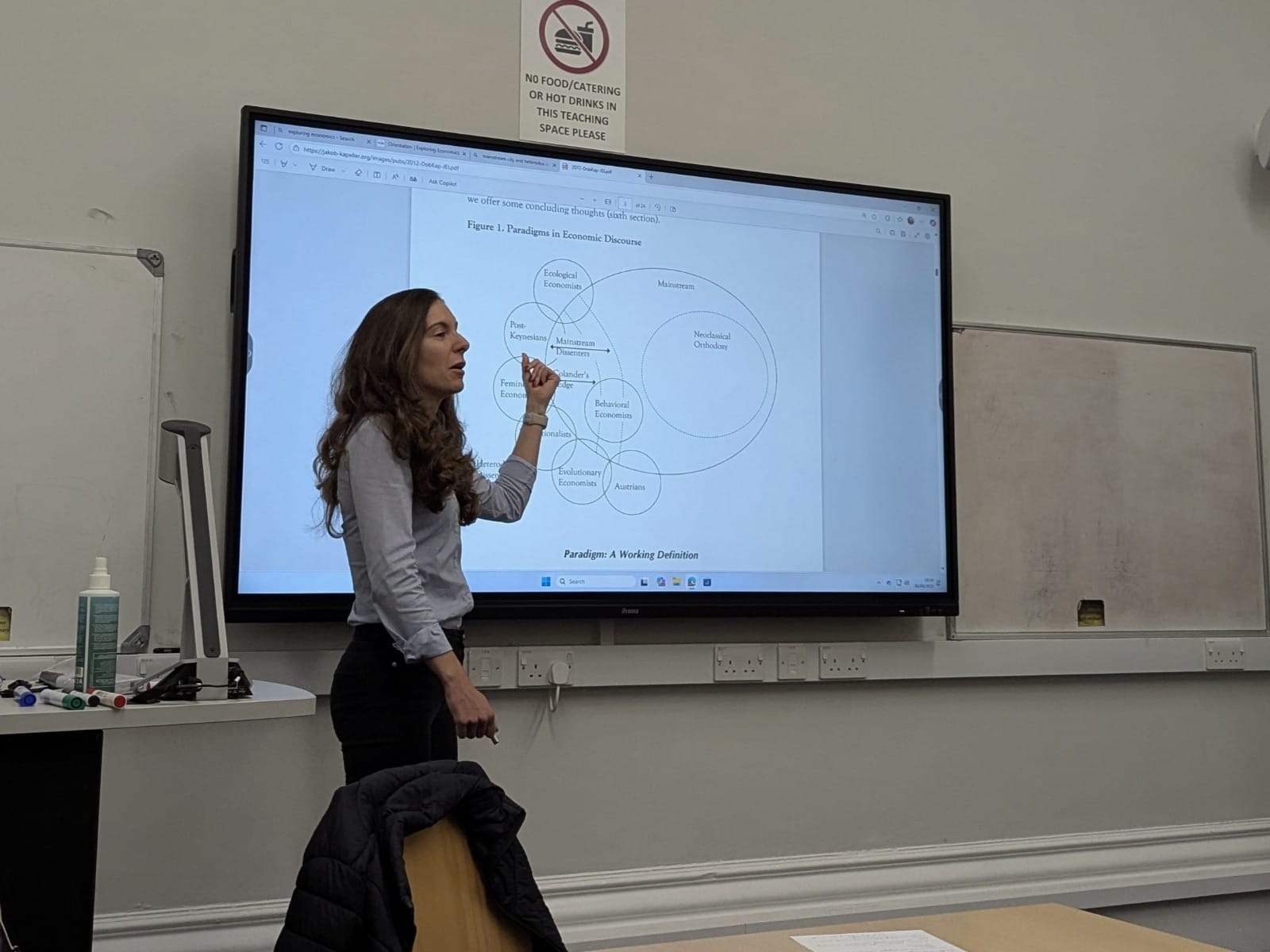
We’ve had 12 events and meetings in total. There were a lot of guest speaker events in TB1, because I happen to know a lot of people. But then are we just a society that does guest speaker events? So in TB2 we pivoted to more discussion groups, PhilSoc-style, which I think helped improve member retention and turnout.
The students that we’ve had attend our events, they seem really interested. ‘People will say ‘I heard this mentioned on the news before, but no one had ever explained it to me in a way where I could then ask questions and interrogate it’. Economics and Politics students will say ‘sometimes we talk about this in our seminars but we can’t really get into it due to time constraints’.
Do you have any exciting plans for PolEconSoc next year?
Book Gary Stevenson.
But really, we have two main objectives for next academic year. The first is to do some kind of mini conference in the South West for all the other societies and people who are trying to do the same thing that we are - make an interesting academic society about political economy.
 Olivia Hunt
But also, just trying to hit that point where turnout at meetings is around 20, 30 people, where there's a real variety of discussion, a variety of views. If students feel confident to express different ideas about the economy and how it intersects with political institutions, social institutions, they can do that, and they can disagree, and they can share ideas, and they can change each other’s minds.
Featured Image: PolEconSoc
Will you get involved with PolEconSoc?