
By Mandari Perera, Third Year, History
Within the film’s first fifteen minutes, French-born Galician director Oliver Laxe makes his intentions very clear. Almost instantaneously, we learn of the meaning behind the Arabic Sirāt, a narrow bridge spanning Hell that all souls must cross in the afterlife in order to reach Paradise. The speed and success of one’s passage depends on their deeds: some cross swiftly, others struggle, and some fail entirely, condemned to fall into the fire below. From the symbolism here alone, we understand that Laxe’s film will not simply stage a journey, but a true katabasis: a trial by passage where survival itself becomes a measure of worth, and not all are fated to endure.
Epigram was kindly invited to an early screening at Watershed.
The film’s opening sequence crosscuts between shots of the Sahara, towering bass speakers, and people dancing to rave music. Sitting in the cinema, seen up close, the potent cinematography renders the ravers’ movement instinctive, hundreds of sweat-slicked bodies surrendering to the EDM (electronic dance music) pulse in the unforgiving heat. I was taken aback (in a good way) by how much real movement there was, the sheer physicality of it made me wonder if this is what I really look like at The Underground with my friends. Stripped of style, there was nothing “cool” about it, only something nakedly, perhaps selfishly human.
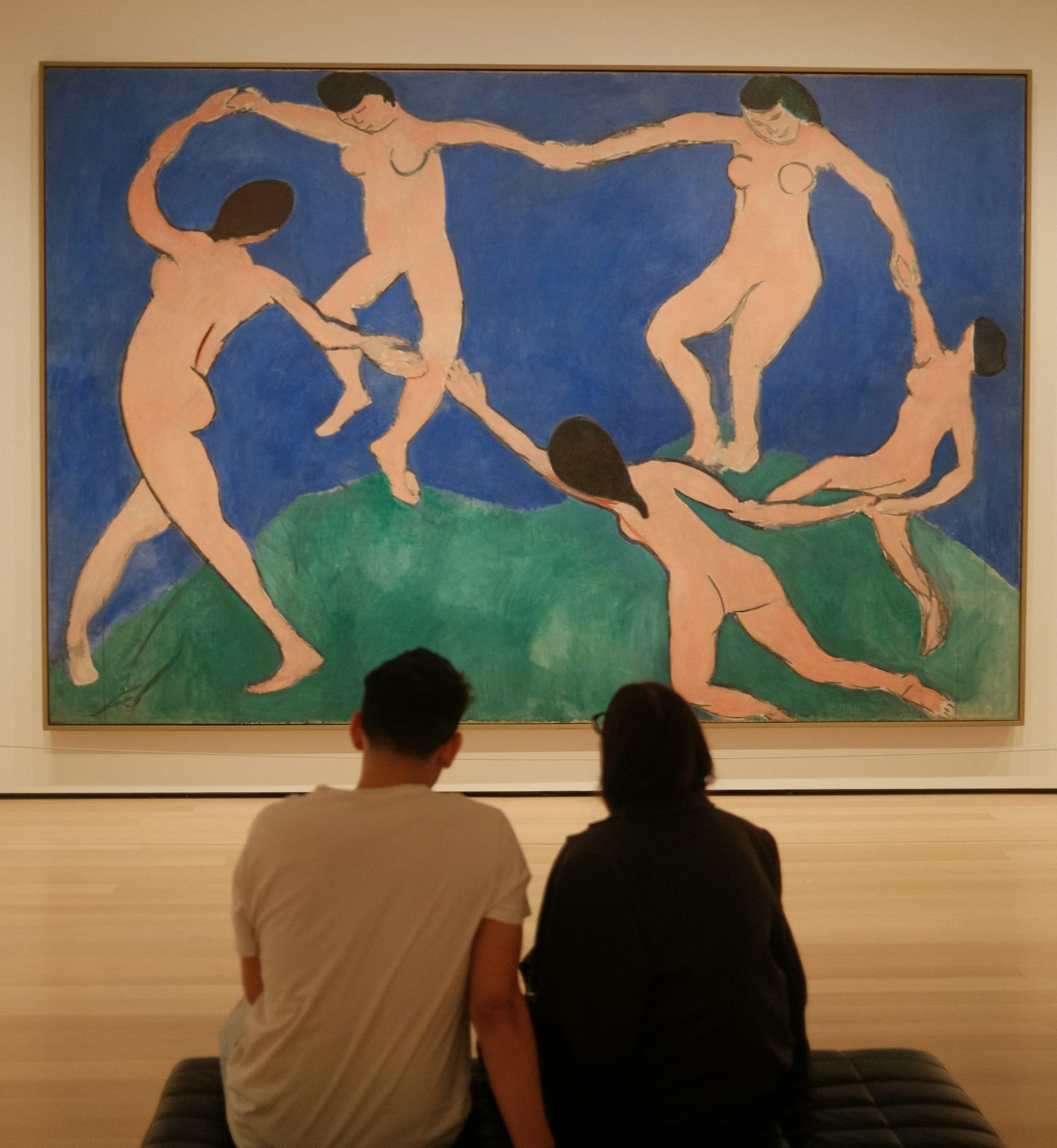
Watching them, I’m reminded (without quite knowing why) of a conversation I had with a friend about Henri Matisse’s The Dance. He told me it was one of his favourite paintings because it makes movement visible within stillness, and I remember understanding exactly what he meant by that. More than any other painting of bodies dancing and gathered in celebration, The Dance feels alive. It feels real. There is an overwhelming sense of movement trapped inside something utterly still.
Watching these ravers, I felt that same contradiction, like Mattise’s figures locked in eternal movement, between stasis and motion, art and pulse. These ravers seem less like performers and more like people surrendering themselves not for spectacle, but for release. Movement as needed. It’s raw, and in that rawness, it feels authentic.
We are then introduced to our Spanish interlopers, Luis (Sergi Lopéz) and his son Esteban (Bruno Núnez Arjona) handing out missing person flyers to the crowd, met with both dismissiveness and suspicion. We soon learn that Luis is searching for his missing daughter, the reason that has driven him and his son to the Sahara.
In time, they earn the reluctant sympathy of a small group: Jade (Jade Oukid), Tonin (Tonin Janvier), Bigui (Richard Bellamy) and Steff (Stefania Gadda) who inform Luis of another party taking place somewhere deep in the desert near the Mauritanian border, where his daughter might be: a secret near-mythic rave, a kind of desert Babylon that they intend to reach.
Having seen all this, I assumed this was the direction Laxe was going to pursue with Sirāt: a thrilling ‘will-they-won’t-they’ search for Luis’ daughter, happening alongside the fragile alliance between two fractured families –the biological one, Luis and Esteban, and the makeshift family of ravers. The film appears to lay out the groundwork for an exploration of unlikely companionships, forged through a shared spiritual journey of sorts.
In doing so, it felt as though the film would perhaps challenge the age-old caricature of rave culture as mere reckless hedonism and self-destructive escapism, acknowledging its authenticity and communal pull within a new world marked by artifice and spiritual erosion. An approach rarely seen in contemporary filmmaking. However, the promise of the first fifteen minutes proves short lived, as the film’s thematic and narrative possibilities eventually lose momentum, leaving behind a story that feels underdeveloped, uncertain of itself, and lacking in structural confidence.
The film is very clearly eager to signal its political awareness, and even aspires to political commentary. Yet, the commentary it seeks to offer is never sufficiently articulated. From the outset, through the military’s clash with the ravers following the declaration of a state of emergency, to the recurring radio updates about the war, to lingering shots of locally displaced people, the film invokes geopolitical ambition. However, this remains frustratingly underdeveloped, merely hovering at the margins. It is gestured at, not grappled with.
This dissonance becomes strikingly obvious in the final act, where we watch the ravers ride a train alongside visibly displaced civilians. When set against the very tangible devastations of war, I found it increasingly difficult to extend sympathy towards them, given that their predicament is a direct byproduct of an aimless pursuit of their next high, with Luis being the sole exception. This contrast reinforces the very stereotype the film initially seemed eager to subvert: privileged Europeans navigating conflict as though it were an aesthetic backdrop.
One of the most heavy-handed sequences that captures this problem in the film is when one of the ravers steps into a sparse room where a television is airing footage of Hajj pilgrims. The cadence of Qur’anic incantation slowly dissolves into EDM beats as Laxe cuts to a shot of a raver crossing the desert floor. This juxtaposition is visually provocative, but it remains exactly that: a juxtaposition. Laxe repeatedly relies on Sirāt’s bold cinematography and great soundtrack to imply depth it never truly earns, in place of narrative rigour and a genuinely interesting story. What should feel textured (particularly given the film’s subject matter) instead feels very ornamental.
It’s very obvious that Laxe intended this journey to be a kind of spiritual ordeal: an odyssey shaped by humanity and fate beyond one’s control. However the film didn’t quite make me feel that way. They are not swept along by fate so much as deliriously poor judgement.
One cannot help but question Luis’ decision to bring his young son to the Sahara in pursuit of his grown daughter who seemingly does not want to be found, or the ravers’ decision to continue chasing their next high in an active state of emergency. If Laxe’s intention was for us to withhold judgement and see them as flawed, and therefore human, the story offers little nuance or psychological depth to support such a reading, rendering their recklessness more exasperating than tragic.
As the increasingly shocking and tumultuous events unfold, the film is successful (at times) in generating anxiety, however, anxiety alone is not the same as narrative momentum or genuine emotional stakes. For a thriller, there is very little genuine thrill, and by the end, the emotional distress seems unearned, as the suffering is reduced to something instrumental –almost a kind of torture porn.
 Josie Horneff
In all honesty, walking out of that cinema felt like I was coming down from a really bad acid trip. It felt disorienting (not in a profound way) and left me wondering what any of it was for. The film possessed great potential, but ultimately, its pursuit of emotional depth felt more asserted than achieved.
Sirāt is on at the Watershed until March 19th, with £6 tickets available for people aged 24 and under here.
Featured Image: Watershed | Star Illustration: Epigram / Sophia Izwa
Will you try and catch Sirāt at the Watershed?