By Charles Hubbard, Second Year Theatre & Performance
Edie Dacosta Jackson and Ed Buckley's relentless but classical new staging of the totemic Greek classic is heavy on the volume, easy on the eyes and almost deliberately free of any tonal modulation.
Medea is one of the most famous Greek tragedies of all time, possibly the single most famous. It's been subject to countless revivals, re-stagings and re-appraisals, not to mention novel-length essays and analyses about how necessarily feminist it either is or isn't. So how can you possibly make a new restaging of Medea stand out from the pack? Well, if you’re Edie Dacosta Jackson and Ed Buckley, you roll it all the way back to the beginning and present a production as classical as student theatre (and its various restrictions) is capable of. The result essentially boils down to a yelling match, sure, but it’s one staged and performed with such confidence and bombast that you hardly mind that Jackson and Buckley never really let their foot off the gas for a single quiet moment.
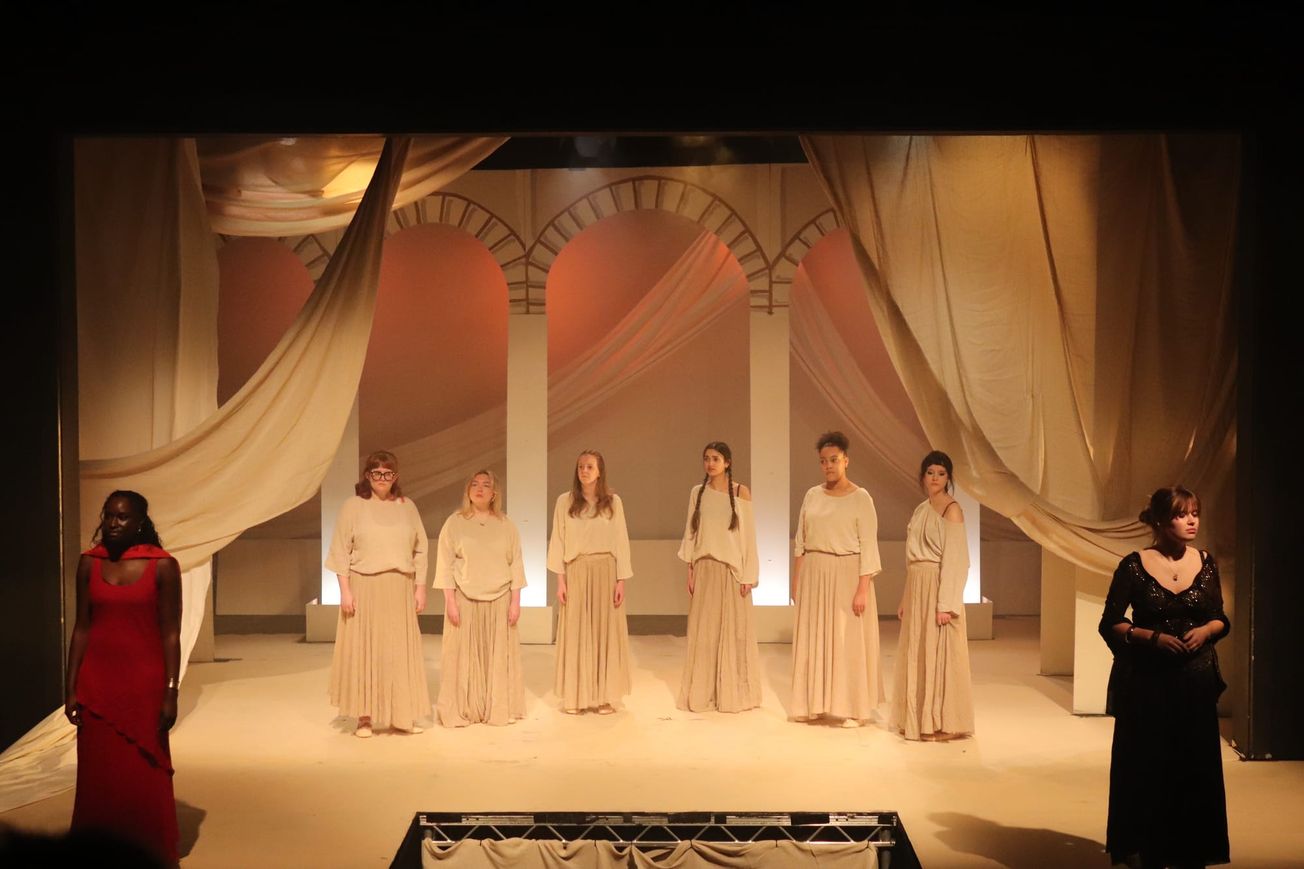
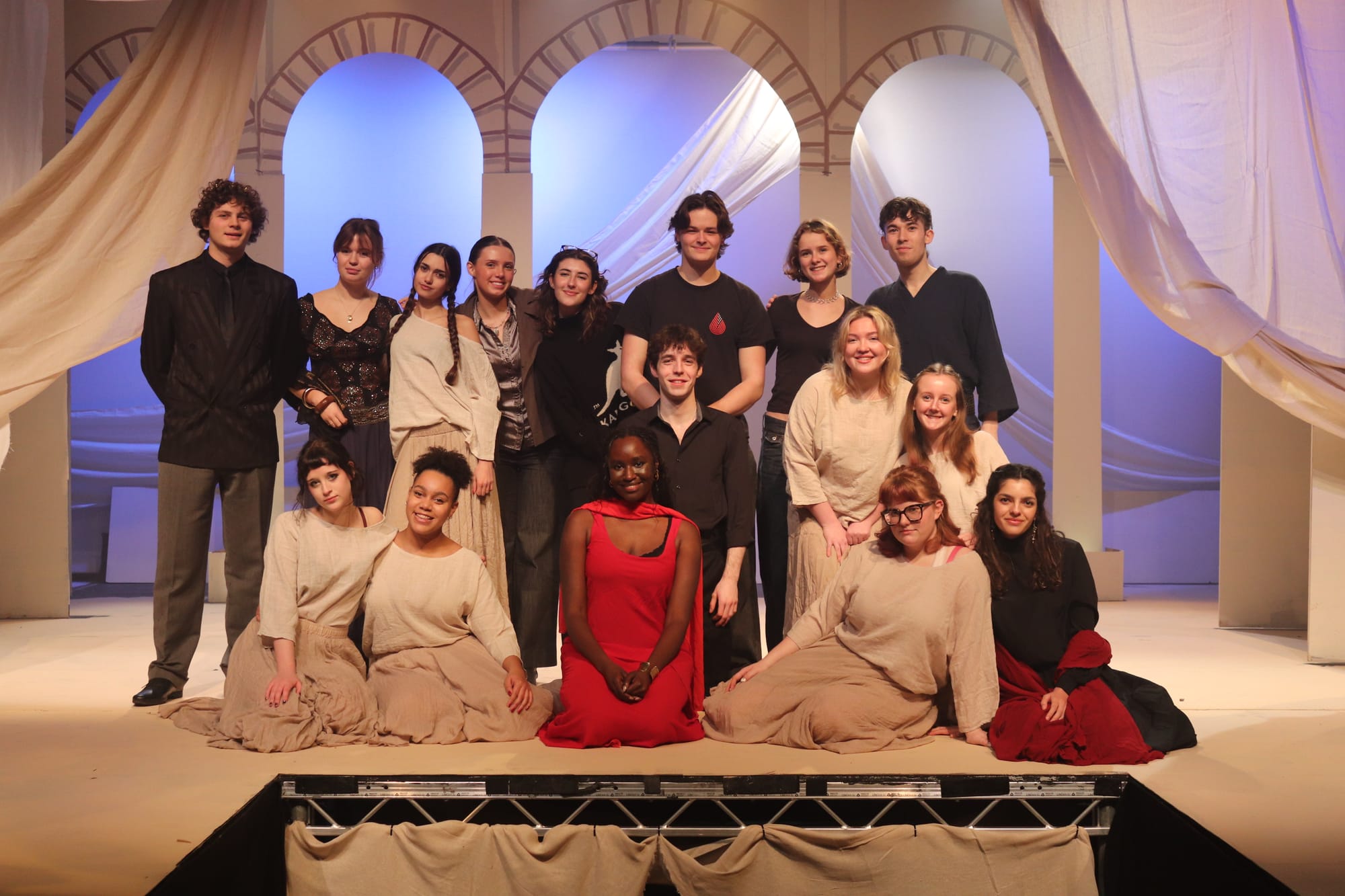
To give some context, the play begins when the inciting incident has effectively already happened. Medea's (Fatima Sabally) charismatic but highly duplicitous husband, Jason (Max Kersey), has cheated on her with another woman, King Kreon's (Sam Fulton) daughter Glauke (Amber Peake) and effectively ousted her from Greek society with only her consciousness for company. The said consciousness, in this production, is embodied by six chorus members (Millie Fairs, Grace Herd, Babs Marles, Niamh McAlister, Molly Parnell and Tapiwa Rwarasika). As her boiling hatred towards her husband and his new bride are left to fester and curdle, she becomes entirely consumed by how best to unleash revenge upon them, leading to one of the most infamous denouements in theatre history.
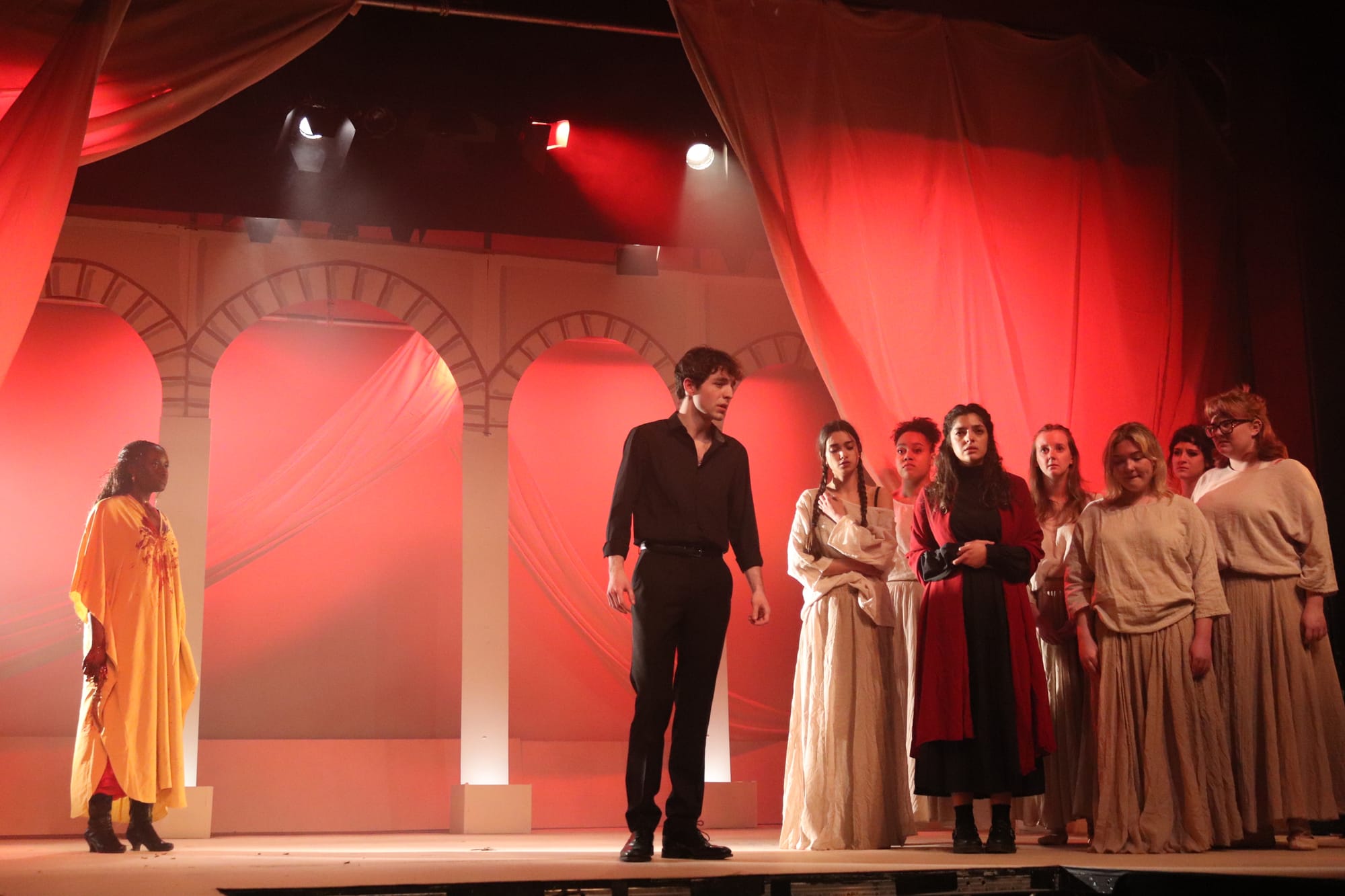
‘It's difficult to imagine the cast bringing this much fire to a smaller auditorium, let alone a rehearsal room’
This adaptation, taken from a production at the Edinburgh Fringe, mostly translates the language into modern dialect (while still leaving plenty of meaty, lyrical prose for the actors to sink their teeth into) and trims out a lot of extraneous material to keep the performance to 100 minutes. Student productions can often feel a little dwarfed by the Winston Theatre's intimidating size and hamstrung by the virtual impossibility of reconfiguring the seating formation. However, the entire creative team here, whether onstage or offstage, feel entirely at home in a venue this expansive. From the force and intensity with which many of the play's most iconic monologues are delivered by performers like Kersey, Ollie Binnie and Maia Cipriano, they might as well be performing to an audience of ten thousand, not a hundred. It's difficult to imagine the cast bringing this much fire to a smaller auditorium, let alone a rehearsal room.
The casting call for this production specifically stipulated a woman of colour to play Medea and the importance of this choice to the directors' greater vision is clear from the jump. Her monologue when she describes how she is othered by the Greek court and discriminatorily seen as fundamentally unstable and dangerous lands entirely different when delivered by a black performer. Sabally's performance (her DramSoc debut) has gotten most of the buzz coming out of this show and she is entirely deserving of it. The script requires the actress playing Medea to be able to lay on false, insincere contrition for the benefit of her larger plan in a way that still makes it clear to the audience, but never her scene partner, that these are nothing more than crocodile tears. A daunting tightrope walk for any actor and yet Sabally walks it with the skill and virtuosity of a professional acrobat.
Equally impressive is Kersey - the only member of the cast to make the verbose language sound entirely conversational. He's also the only actor to be costumed in modern dress, making him seem less like a monstrous demagogue and more like someone you could encounter on the street (or in a lecture theatre), causing his insidiousness to feel all the more unsettling. If there's one false note of casting in the production, it may be Binnie in the role of the manservant. Binnie is an effortlessly magnetic performer and a firm stalwart of the Bristol performing arts societies, which makes him feel slightly out of place in what is introduced as a fairly perfunctory role. Cipriano handles this balance much more adeptly, stunning the audience speechless with her bravura opening monologue and then skillfully switching modes to blend in with the ensemble for the remainder of the show. Binnie, by comparison, is always in danger of taking to the spotlight a little too soon, meaning that his eventual outburst (which he handles with characteristic panache and unreservedness) feels more like an inevitability than the shock it probably should be. I'm afraid this might be a rare example of an actor being too charismatic for a role.
The inclusion of the chorus is an excellent depiction of Medea's isolation as she is driven more and more into the depths of loathing - and the six performers certainly handle the material well, with Herd in particular given a heartbreaking final moment centre stage. The decision to have them enter from the orchestra pit is also a striking way to begin the show. However, does it really justify the fact that, because of it, no performer can ever quite take to downstage centre? Answers to this question will no doubt vary by audience member. If Sabally or Kersey make a move from one side of the stage to the other, they must tiptoe around the opening of the pit. Half the time, the strength of the performance was more than enough to distract me from this fact. The other half, I couldn't help but notice the way the blocking was being kneecapped.
 Alex Boersma
It’s an intense production and one whose sparseness of quiet moments may be likely to turn some audiences away, especially with the lack of an interval. However, the glaring pace and vivacity of the show is certainly a better fit for Euripides' original text than one which allows its audience (and performers) to breathe a little more often. Buckley and Jackson have proved that they can handle character psychology and a cast of heavy hitters as well as any of their DramSoc contemporaries. I’m afraid the production's already closed so there's no chance of seeing it now but those that did bore witness to a brash, riveting restaging of Euripides' classic text.
Featured image: DramSoc / Laurie Morgan
Will you watch DramSoc's next production?