By Hana Sakurai Wernham, Second Year English
Anticipatory chants of ‘Nuuuman!’ are silenced by the rushing synth riff that opens ‘This Wreckage’, the opening track from Telekon. Like most Numan synth motifs, it's perfect: tonally ambiguous, moving upwards without an obvious melodic destination, dark cracking open into light.
When I describe the riff as ‘rushing’, I am not describing a quickness of tempo but rather the feeling of your stomach dropping while the rest of your body levitates slightly as if shocked by short-circuiting wires.
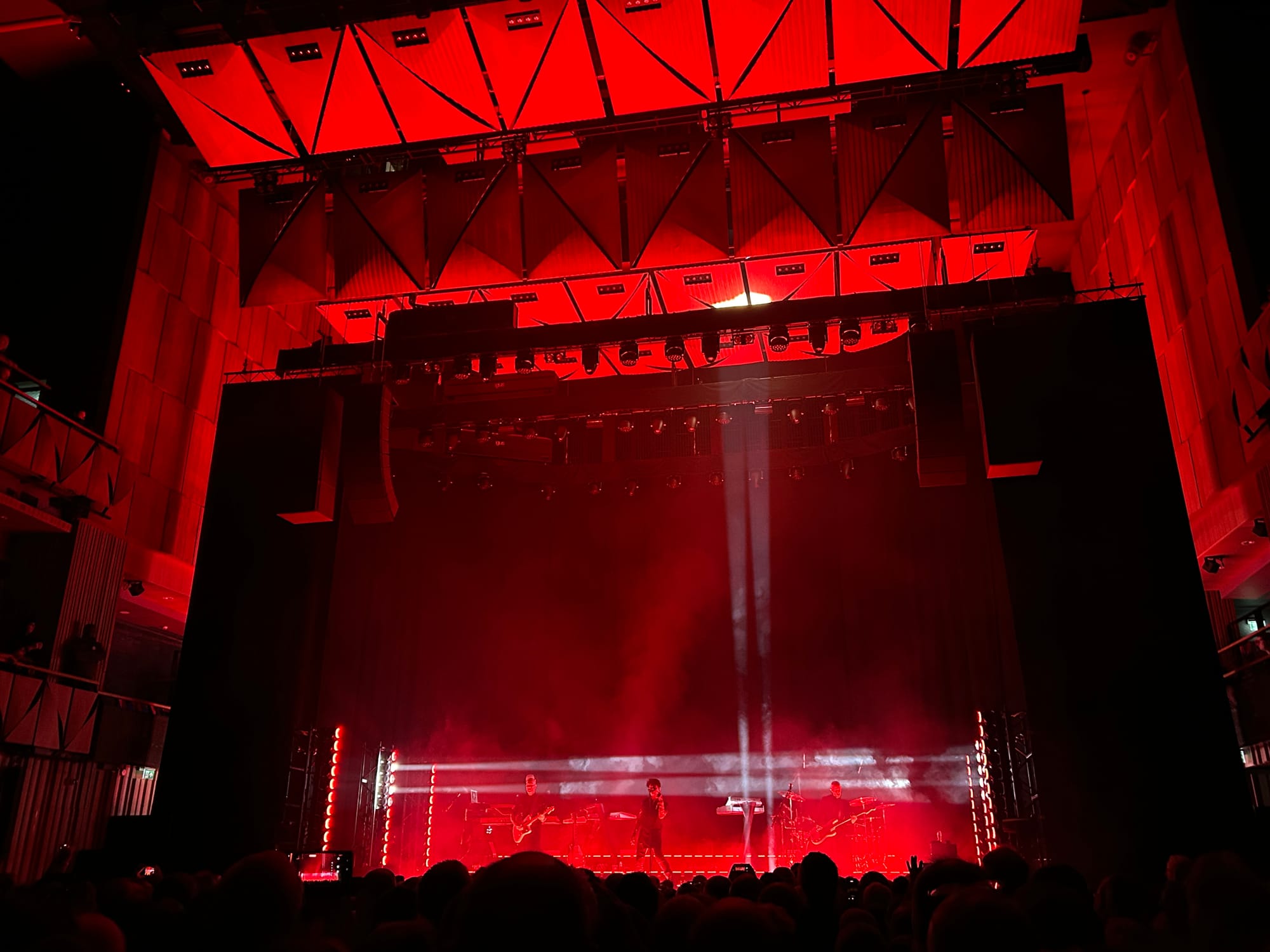
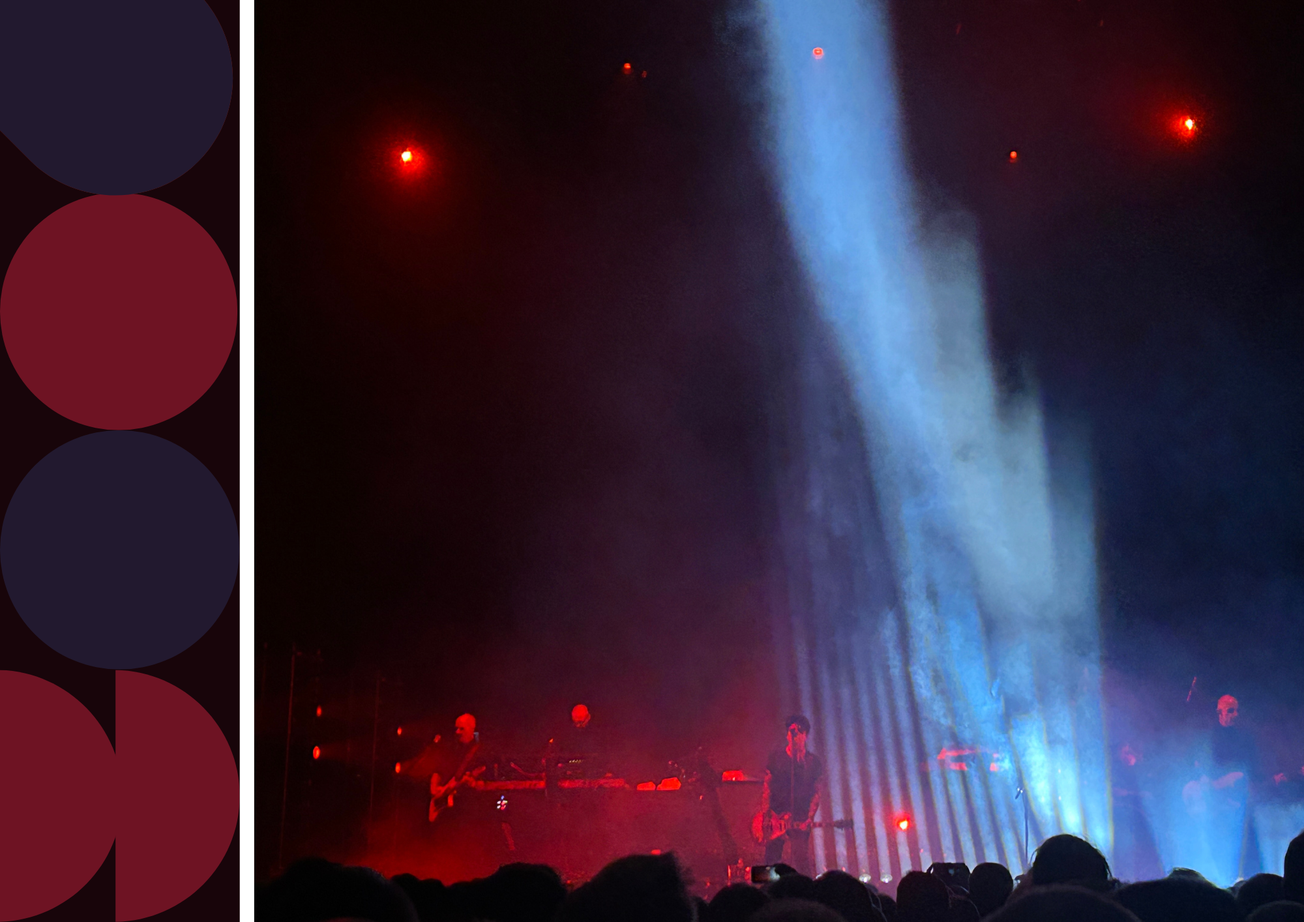
The band enter onto the stage, super sleek: clad in black shirts with black ties, shaved heads, they are the men-machine behind the sound. Then there’s Numan, smudged black eyeliner and big spiked hair. He’s substituted the usual black ribbons tied around his arms and neck for red ones, a nod to the colours of Telekon.
Incidentally, it makes him look a little coquettish, rubbing slightly with his otherwise post-apocalyptic look. He pulls it off though, of course, and it’s perhaps an understatement to call his colour scheme a ‘nod’ to Telekon. In fact, he embodies the album, the red beams of light intersecting at right angles frame his face as if it is emerging bodiless out of the darkness as in the 1980 album artwork.
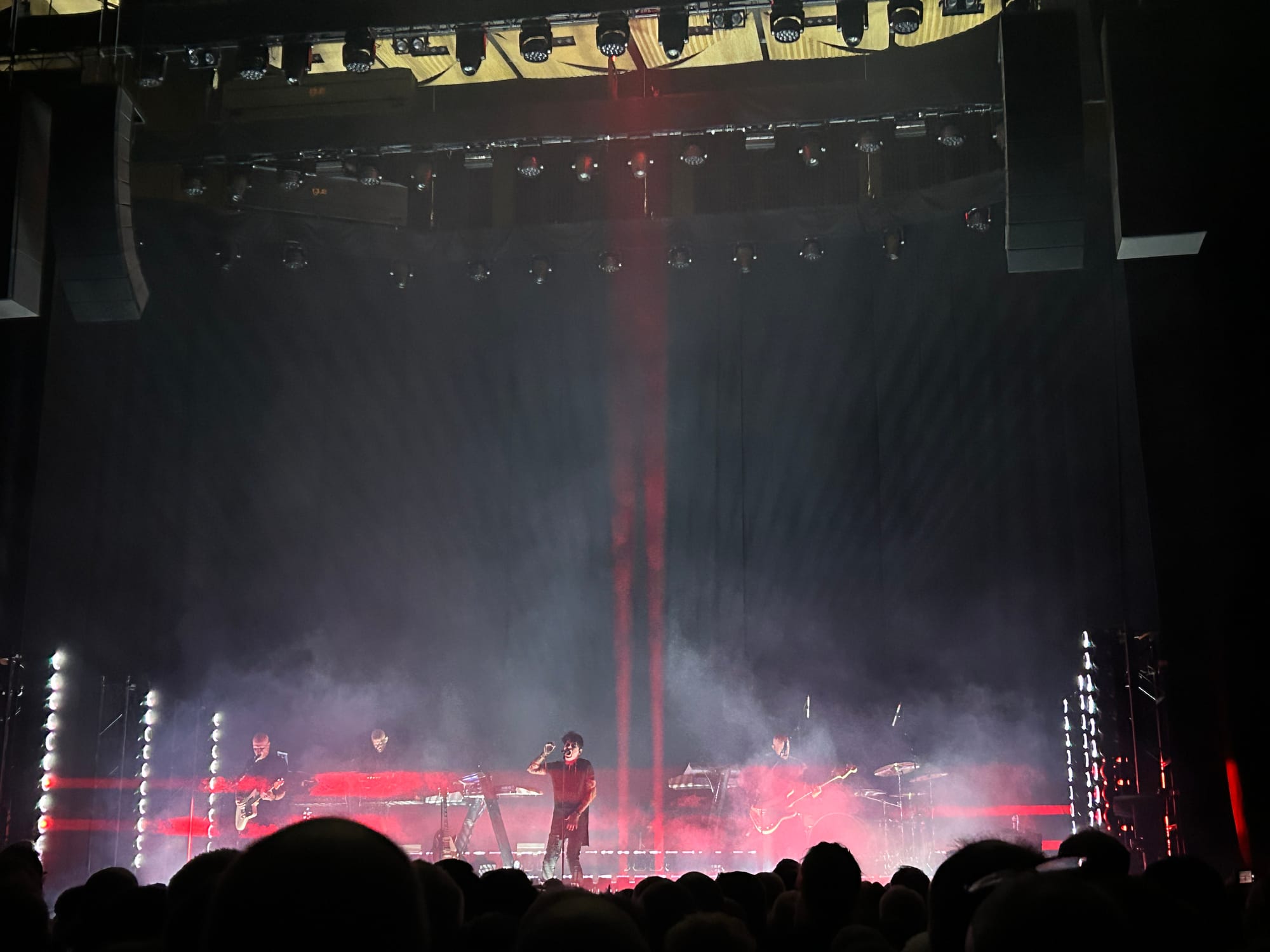
Numan’s voice hasn’t changed in the forty-five years since the album release, still possessing that synthetically warbled timbre that so closely mirrors that of the synths he uses. He sings through the set with ease, moving his arms about his performance hitbox in a geometric fashion, drawing up squares and lines like the ones on Telekon’s cover.
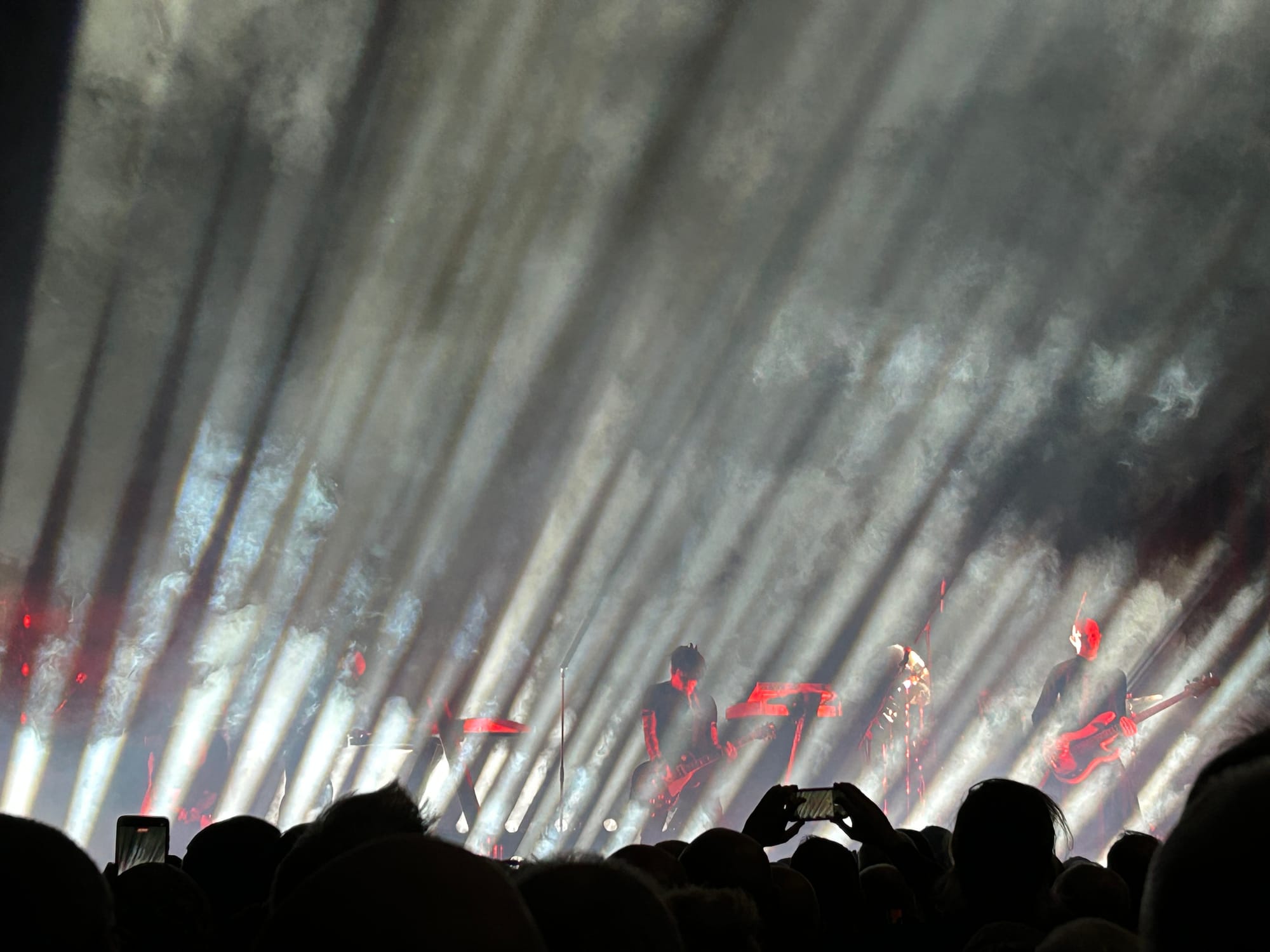
The Beacon’s capacity for complex lighting is fully exploited: white beams like rows of columns cut through plumes of smoke; apocalyptic green swathes the stage; fog lit red rises like mist from upstage, eventually obscuring Numan when the lights flash white. It has a ‘coming of the Martians’ feel; alien, ominous, but with the current trajectory of planet earth I would readily submit to Numan and his spaceship-mates.
There is a lull when the twinkling falling melody of piano-led ‘Please Push No More’ is heard. It’s a song with a Satie-esque ambiguous sadness. It’s simple, instrumentally pared down, and largely in the piano’s upper, lighter range. But every note feels unbearably heavy.
Numan feels the weight of his own composition too – he breaks down on stage, becoming unable to sing. It wasn’t until few days after the gig that Numan shared on social media the reason for his struggling:
The day before his Bristol appearance, Numan found out his brother had suddenly passed away. Numan wrote, ‘this tour is no longer a celebration of an album, it’s a tribute to John, my brother, the best brother a man could ever have.’
A spirited revival of the nearly fifty-year-old album, the gig was indeed a fitting tribute to his brother who was only fifteen at the time of Telekon’s release, and who ‘loved’ the album. Numan continued to perform with incredible verve, enchanting a concert hall filled with fans old and young who clapped along to the driving ‘We Are Glass’.
He performed ‘Like a B-Film’, that didn’t make it onto the original album ‘which means it was too shit’, Numan explains jokingly before immediately proving himself (and his old label) wrong; the song is slow yet propelling with an aloof spoken melody and Numan’s signature pedalled synths that rattle from one ear to the other.
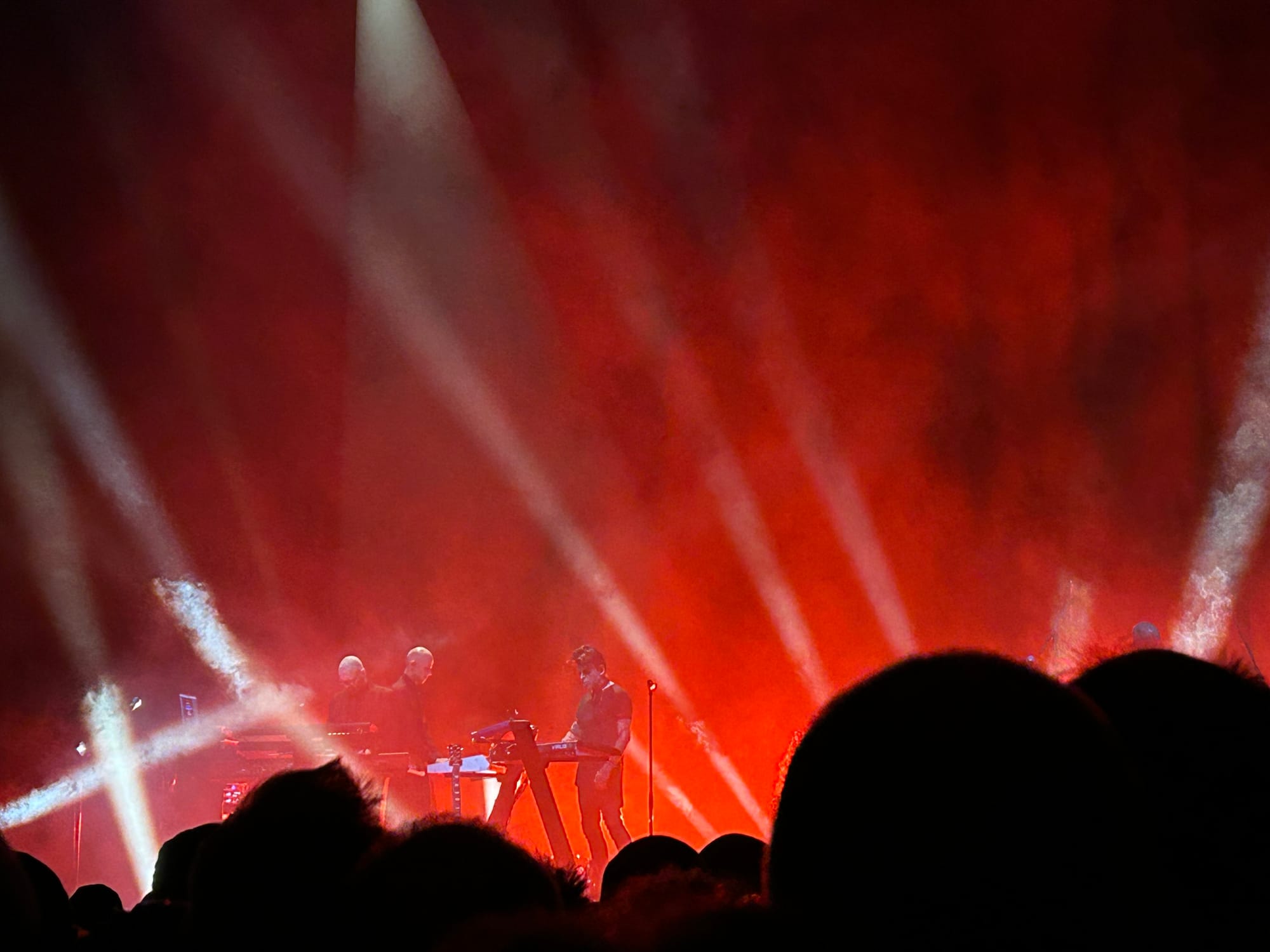
In the rapturous encore, Numan and his band deliver a package of Tubeway Army songs which are very well received by a nostalgic crowd. Triumphant is the word. Even after the band exit, chants of ‘Nuuuman!’ persist: the audience’s own unknowing tribute, perhaps, to John Numan as well as his musician brother.
Featured image: Hana Sakurai Wernham
Have you listened to Telekon?