By Zavié Goutorbe, Fourth Year, Physics with Study Abroad
We need to talk about Stadium Connectivity. Have you ever been to a match and not been able to connect to a network? You don’t walk alone. A 2023 Boldyn Networks report claims that poor Stadium Connectivity is something that 77% of stadium event-goers can’t abide.
Now, Project ARANA, a collaboration between project leaders Weaver Labs, Madevo (a University of Bristol spinout) and the UoB’s very own Smart Internet Lab, seeks to redress these issues. Backed by £3.6m worth of government funding, the project is a UK first, and has already undergone testing at Stadium MK in Milton Keynes, where further trials involving fans are slated for 2026.
Per an official statement, Prof Dimitra Simeonidou OBE, Director of the Smart Internet Lab at UoB, explained that “thanks to 5G broadcast capabilities, the app offers a cost-effective alternative to traditional cellular solutions which is particularly important for large sporting venues where mobile connectivity is often unreliable during peak usage.”
This assessment matches the matchday experience of Max Baldock, a Masters student studying Policy Research at UoB, devoted Arsenal supporter and regular attendee of matches at all levels, from Non-League to the Premier League, who testified that “the larger the ground, the worse the connectivity.”
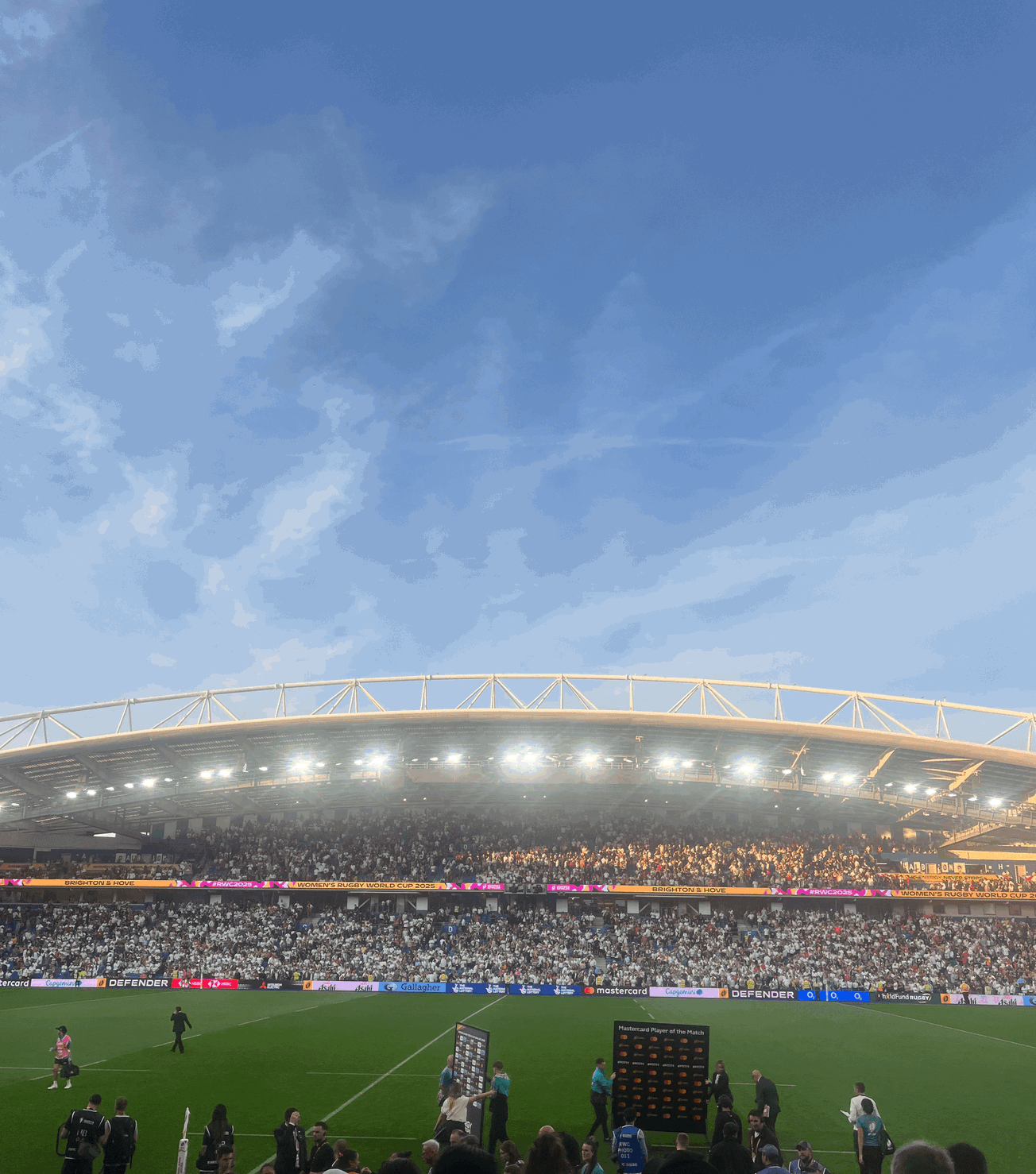
Save for Brighton’s Amex Stadium (capacity: 31,876), where he enjoyed a good connection during the 2022 Women's Euro Quarter-final encounter between England and Spain, he reserved praise for the grounds of Eastleigh, Barnet (in League 2 as of this season), Dagenham & Redbridge and Bath City, none of which have a capacity of more than 10,000, but which all provided him with good network connections.
Tom Flint, the 2024-25 UoB Football Club (UBAFC) Club Captain, shared his thoughts on the matter. “From a fan's POV, as anyone who has ever been to a Premier League football match will attest, connection issues are widespread and continue to be an issue despite recent action taken.”
This recent action is noteworthy, as an increasing number of stadiums have been implementing faster broadbands. Indeed, free WiFi has been offered at the Amex since 2014. Since then, Brighton have taken steps to implement a multi-carrier solution in partnership with the Focus Group, further boosting connectivity. Another example is Wembley. From this year onwards, the spiritual home of English football will have its own dedicated 5G standalone network provided by EE. As for Sunderland’s Stadium of Light, as of this year, the sixth largest UK football arena also has an enhanced 5G network, supplied by Boldyn Networks using a Connectivity-as-a-Service (CaaS) model. The Tottenham Hotspur Stadium remains the UK benchmark since opening in 2020, with WiFi access one of many state-of-the-art features.
The Project ARANA collaboration stands out, in that it uses a Network-as-a-Service (NaaS) model, making it more scalable and service agile than traditional solutions. The existing stadium network is integrated with a private cloud-based 5G network, which is then enhanced by Madevo’s AI technology. This leads to what may be termed a “smart stadium”, a venue with state-of-the art technology. The possibilities of this technology go far beyond football. As well as telecoms, the applications of Madevo’s agentic AI range include Rail and Transportation, Utilities and Energy, and Logistics.
Let’s return to our primary concern: how will these efforts shape the fan experience? One of the potential impacts of the technology will be the real-time ability to access high resolution live feeds with multiple camera angles, which Flint believes will “undoubtedly lead to an unprecedented viewing experience.” It’s difficult to argue with this assessment given how hard it can be for fans to follow often confusing off the ball ongoings, with Flint supplying the example of “being able to watch along with VAR during controversial decisions.”
Other putative benefits of the technology include enhanced live AI analytics, which may be of particular interest to coaching staff, and fans being able to order food and drink directly to their seats, a bit like in a Wetherspoons. Baldock considers this latter point a positive aspect that the technology will bring, noting that “ordering food will stop [fans] having to queue up at the bar and miss the game”.
There is profit to be made. Weaver Labs estimate that the revenues of stadiums that use their NaaS-based solution will be boosted from legacy solution revenues by up to around 210%, as it is predicted that the number of attendees and net revenue per attendee will rise significantly. Although a significant proportion of fans would willingly spend more, it should not be forgotten how expensive a matchday can be. Baldock admits that he has spent almost £100 before when factoring in transportation costs (in his case, train tickets).
It must be noted that all the fans that supplied their thoughts raised the question of how the social aspect of the matchday experience would be affected.
“The way I see it, it would be way worse for the atmosphere,” opined Baldock. “The purpose of going to a game is to watch the match and not a phone screen,” he added.
Flagging the same issue, Flint stated, “in a world where it is ever increasingly difficult to avoid being glued to a screen, live sports events may no longer be a place where people put down their phones.”
The message is clear; for football purists, going to watch a match means exactly what it says on the tin.
Improving Stadium Connectivity is part of a wider trend of applying advanced technologies to the world of football. This includes the grassroots level, where the UoB-developed Pitchside AI enables amateur footballers to be able to use AI to analyse their performances as if they were professionals. At the very top end of the game, River Plate, the Argentine powerhouse, have implemented facial recognition technology at their 85,000 capacity Mas Monumental ground, which reportedly speeds up the ID verification process, improving security in the process, making it harder for banned fans to sneak past security. Superior safety and security measures are also set to be enabled by Project ARANA.
Live and in-play football betting are both increasingly popular, and the enhanced venue connectivity will surely also cause the betting landscape to change, though how exactly remains unclear.
As might be expected, the implementation of such technologies, specifically AI, is not without its challenges, notably legal ones. Jon Morgan, partner at Onside Law, a specialist sports law firm, commented, “we are seeing an increasing use of AI in the sports industry generally, and in-venue deployment is no exception. Whilst AI provides many opportunities and benefits, venue owners will need to be alive to challenges and various legal hurdles to overcome, including data privacy considerations in particular and a changing regulatory landscape in respect of AI itself.”
"Whilst AI provides many opportunities and benefits, venue owners will need to be alive to challenges and various legal hurdles"
Come what may, the football technological revolution is here to stay. Project ARANA’s success throughout its initial phases offers fans a glimpse of what they might expect to experience on a matchday in the future. So, next time you’re at a game, don’t be surprised if your connection actually works. Do take a moment, however, to think of the technological ingenuity that was required to make this possible, but also consider, is it delivering the experience that you want?
What have your connection experiences been at live-sport events?
Featured Image: Epigram/ Emma Griffiths