By Nel Roden, Features Editor and Will White, News Editor
Trigger Warning: Mentions of rape and sexual violence.
Since their launch in October 2024, Enough, a self-swab rape test kit company, have established a known presence on campus. Their orange hoodies and paddling pools filled with self-test kits are now a recognisable sight for many students on their walk around university, and were even featured at the beloved end-of-year formal event, Winestock. The kits themselves offer a ‘simple, quick and discreet way of reporting rape’, with Enough claiming they will increase reporting rates and act as a deterrent. Enough sees itself as ‘the service that survivors are asking for.’
In a statement to Epigram, one Enough ambassador writes: ‘We have brought conversations of consent into daylight – in university houses, across societies, and throughout campus.’ One of Enough’s goals, the same ambassador later notes, is ‘to stop inaction.’
And they do appear to be making progress. Enough’s Co-Founder, Katie White, told Epigram that 200 rapes had been reported to Enough since November. A survey of 252 students conducted by the organisation in April this year found that 86 per cent say they would report with the company. Here to offer a reporting alternative for the ‘90 per cent [who] do not want to report officially’ (85 per cent if including those reporting to Sexual Assault Referral Clinics), Enough has positioned itself as a radical solution to sexual violence. But not everyone is convinced.
On Monday 26 May 2025, University of Bristol student Lucy Hobday published an open letter – now signed by 302 students and 13 societies including Dance Soc, LGBTQ+ Soc, and Criminology Soc – requesting that the Students’ Union and the University of Bristol take action to ‘protect’ students against self-swab rape test kit company, Enough. Despite stating on their website that ‘70 per cent of Students are already saying that they think Enough is preventing rape in Bristol’, dissatisfaction on campus remains. So why is a service designed to give survivors the opportunity to report on their own terms sparking backlash?
It all started with an Instagram account. Launched by Hobday in late April this year with a post titled ‘We’ve had enough of Enough’, the account, @enoughofenough, now has 22 posts, all of which detail grievances with Enough. Her reasoning for starting the account, Hobday told Epigram, was simple. She explained: ‘I wanted to create an online space to inform students so they could have a full understanding of what they were signing up for if they used an Enough kit.’
But the concerns Hobday has raised are not the only criticism the company faces.
In early September 2024, the Faculty of Forensic and Legal Medicine released a position statement on self-swabbing kits. While the Faculty encourages organisations interested in combating the rape crisis, it ultimately concludes that, unless stringent guidelines are followed, self-testing ‘puts survivors at risk.’ The statement cites self-swab kits’ inability to offer physical and mental health support, issues surrounding courtroom admissibility, inability to provide safeguarding for vulnerable survivors, and the lack of evidence that kits act as a deterrent as its primary points of concern.
Concerns were reiterated in November 2024 in a joint statement by NHS England, Avon and Somerset Office of the Police and Crime Commissioner, and multiple Bristol-based sexual assault support services, among others. For reasons echoing the FFLM, the statement explicitly warns against self-testing: ‘It is recommended that you do not take a swab yourself.’
As of 7 July 2025, @enoughofenough stands at 924 followers, with the open letter representing what Hobday describes as the ‘entire point’ of what the account is trying to do.
Speaking to a discontent with Enough’s practices and presence on the University of Bristol campus, the letter addresses seven claims against co-founders Tom Allchurch and Katie White.
The first alleges that the company has ‘Targeted drunk students for promotional purposes.’ Hobday told Epigram of her own experiences with this when earlier this year ‘five or six representatives filmed themselves giving me a rape kit when I was too drunk to say no or understand what was going on.’ Once brought to their attention, Enough apologised, telling Epigram that ‘on the few instances where people change their mind or there was any level of miscommunication we apologise and remove.’
In a survey conducted by Epigram, one student wrote of their experiences being approached on a night out, remarking that it can be ‘so triggering for someone who has experienced [sexual violence].’
‘As previously stated, we do not promote or endorse the Private Limited Company known as Enough’
Enough were asked to hold an interview with Epigram to discuss the specific claims levelled in the open letter, but declined to do so, instead providing general response statements. On the allegations, Enough wrote: ‘It’s incredibly distressing and disappointing to us to see this misinformation, mis-representation of information and personal attacks on Enough and our team.’ The organisation denies the claims made in the open letter.
Another allegation alleges that Enough misrepresented the SU’s reporting processes. Bristol’s Students’ Union has publicly declined to support Enough, with an SU spokesperson telling Epigram: ‘As previously stated, we do not promote or endorse the Private Limited Company known as Enough. This is based on concerns raised by the NHS, police, and local support services regarding the use of self-swab tests.’
Having now met with Hobday alongside the University regarding the contents of the open letter, the SU has pledged to review the issues, saying, ‘We take the concerns that they have raised extremely seriously.’ They plan to meet Hobday for further discussions soon.
The open letter claims Enough to have ‘undermin[ed] student understanding of and trust in their student[s] union’, leaving students ‘less confident in turning to the SU for support and protection.’
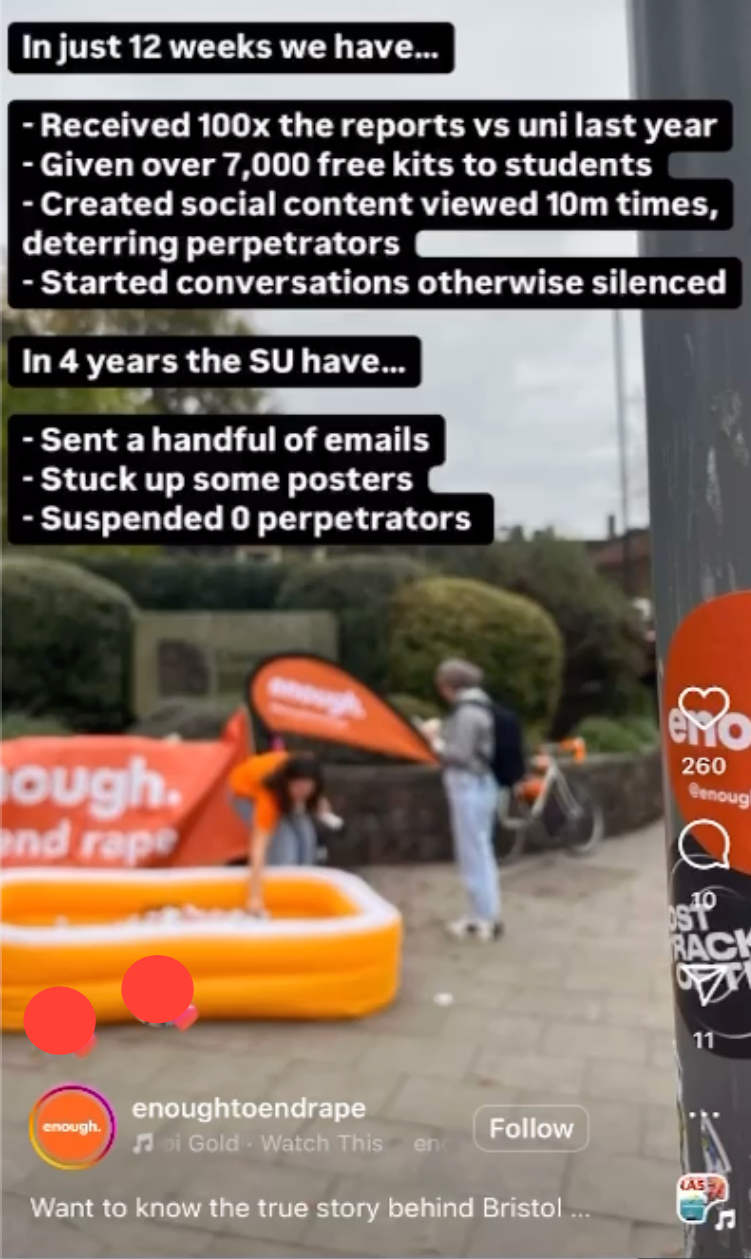
In a video posted on the Enough Instagram account, the company claim the SU ‘suspended 0 perpetrators [of sexual violence].’ An FOI request from April 2024 reveals that of all relevant cases since 2021/22, no students have been permanently withdrawn from the University of Bristol on account of sexual misconduct. The SU, however, have ‘separate reporting structures and separate risk analysis’, as one student who formerly worked with Enough notes. Responding to this, the SU told Epigram:
‘We have enacted precautionary measures this year, more than once, but we will not discuss specific instances or provide further information due to the confidential nature.’
In October 2024, the SU introduced their Disciplinary Policy as part of the code of conduct review – a step towards codifying accountability measures done in collaboration with the University of Bristol Ladies Hockey Club (UBLHC). Detailing a framework for managing allegations of misconduct, the Policy stands to ensure disciplinary action is, as the SU tells Epigram, ‘applied fairly and consistently.’
Emphasising their commitment to student safety, the SU added: ‘We are committed to providing an environment where all students are safe and respected. We do not tolerate sexual violence or misconduct. You are not alone, and the right services are on hand to make sure you get the help you need, should you need them. This year we’ve worked with partners across the city on a campaign to raise awareness of the critical work of SARCs.’
Their stance is echoed by the University of Bristol, who also work closely with partner organisations across the city to address issues of sexual violence. ‘We care deeply about all our students’, a university spokesperson tells Epigram, ‘and are committed to providing an environment where everyone feels safe and respected.’ The spokesperson also reiterated that the university has no relationship or affiliation with Enough.
When asked about the video, Enough told Epigram that the ‘small mistake’ has now been corrected in the caption, which now reads: ‘Please note 0 perpetrators suspended refers to the university not the SU.’
The open letter goes further, alleging that Enough has ‘intimidated’ students who questioned the company’s mission. Student journalist Will White was contacted by Tom Allchurch in March via LinkedIn following Epigram’s coverage of Enough, despite having not been involved with the original article himself. In the message, Tom Allchurch cites a slew of statistics regarding sexual violence and its prosecution, noting the ‘4 per cent chance’ Will White’s ‘women friends’ had of getting raped.
‘As someone who has gone through a SARC, they are as person-centred as they can be.’
Tom Allchurch went on to address questions regarding the admissibility of Enough’s self-swab kits, stating that such questions are ‘not really controversial’, and that they are being ‘whipped up by the SARCs who are worried about their funding.’
SARCs, or Sexual Assault Referral Clinics, are sexual violence support services typically provided by the NHS. They offer free and confidential support for those who have been raped or sexually assaulted, including forensic medical examinations (if assault has occurred in the past seven days) and the option to store examination evidence – whether or not a survivor chooses to report to police. SARCs can also provide free STI and pregnancy testing, and with over 50 centres across England, they serve as a critical first point of care for survivors.
Responding to Tom Allchurch’s claim, one ex-ambassador told Epigram: ‘I think that is a much stronger reflection on Tom Allchurch […] than it is on SARCs.’ She went on to call the statement ‘ignorant’, adding that ‘any concerns that SARCs raised about admissibility are out of genuine concern for the people that would need to use these kits. […] As someone who has gone through a SARC, they are as person-centred as they can be.’
On their website, Enough voices that in the instance where rape or assault has occurred, survivors should ‘go to the police or a SARC first if they want to.’ In their statement to Epigram, Enough cites existing services as being ‘part of the solution, but not all of it’, proceeding to claim that ‘Enough isn’t instead of them, it can complement them.’ They continue: ‘SARCs support 5 per cent of survivors, 23 of the 100 major UK universities do not even have a SARC in their city.’ Bristol, however, does.
The Bridge, Bristol’s SARC, provides medical and forensic support while also offering survivors the chance to speak with a trained professional about their experience, along with referrals for counselling. The Bridge is funded by NHS England and Regional Police & Crime Commissioners for Avon & Somerset, Gloucestershire and Wiltshire Police.
‘Obviously more could be done in existing services. No one’s denying that’
‘My worry’, one student who was formerly involved with Enough told Epigram, ‘is that Enough takes all the spotlight, and there wasn't much spotlight on The Bridge to begin with.’ One ex-ambassador reiterates this concern, telling Epigram her belief that ‘so much of [Enough’s] communications is inherently alienating people from existing services.’
She continued: ‘Obviously more could be done in existing services. No one’s denying that. But there was never acknowledgement of how much [SARCs] actually do and how much they provide for people who are in need of their services. It was just this kind of like, “Oh, [SARCs] don’t agree with us. That’s a problem we need to deal with.”’
Despite this, one current ambassador claims that because of Enough, ‘more people now know what a SARC is and how to access one.’ Enough themselves remarked to Epigram that, ‘After having conversations with people who disagree [with the company’s mission], it becomes clear that their frustration is with the system.’ They did not comment on the message sent by Tom Allchurch to Will White, nor his remark regarding SARCs.
Further allegations detailed in the open letter allege that Enough: ‘Illegally collected students’ phone numbers’, ‘Established a pervasive presence outside of university buildings’, ‘Repeatedly entered student-only areas in order to distribute and display marketing materials’, and ‘Repeatedly entered student-only areas in order to film students.’
Responding to the final claim listed, Enough told Epigram: ‘Students have thanked us for being in student hot-spots [...] We only speak to people if they want to have the conversation.’ They did not comment on the presence of Katie White, who is not a University of Bristol student, in a Ucard-access-only area on campus.
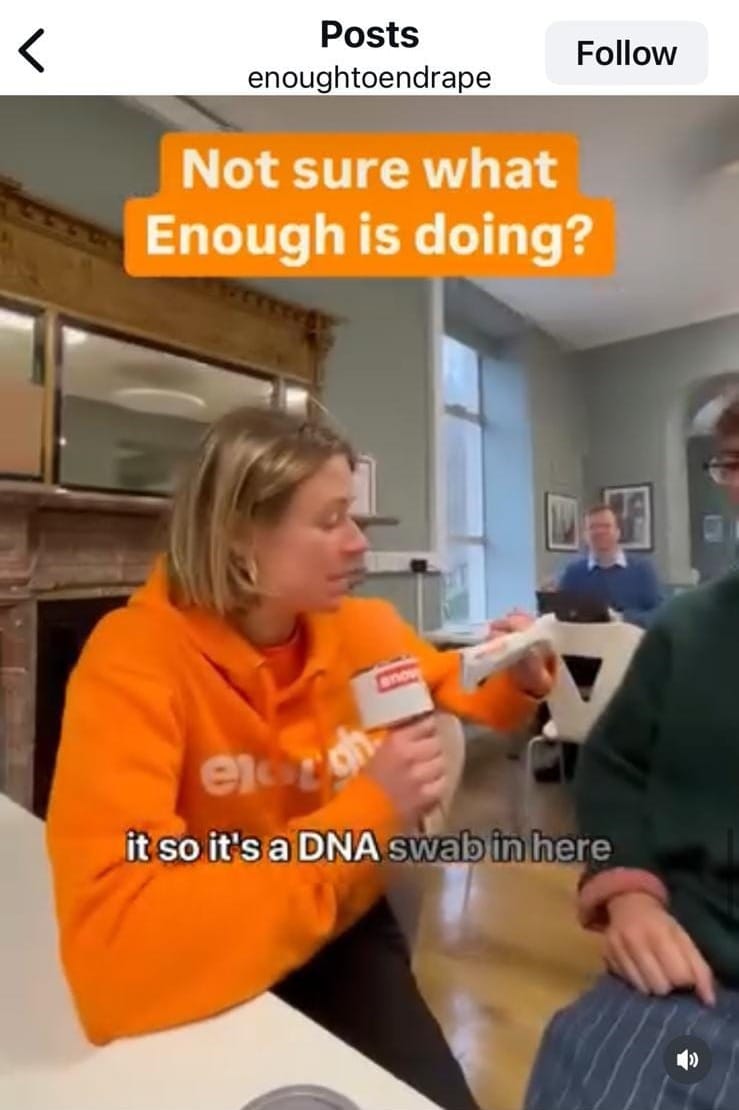
In response to the open letter more broadly, Enough issued the following statement to Epigram:
‘We are [in our] early days, wanting to learn, always open to constructive criticism but the individual/group behind this account seem set on destroying Enough. It makes sense to be angry at the situation today, but it perplexes us why that would be directed at one of [the] few organisations making a tangible difference.
Instead of tearing down a solution which shows hope for survivors, why not direct criticism towards helping us improve?’
In a later statement, Katie White added: ‘Of course there are a few who don’t agree, that’s their personal opinion and is ok. But the most common question students ask is “How does this not already exist?” They thank the Enough student ambassadors for stopping young women being raped.’
Yet for Hobday, the letter is not about undermining Enough, but about demanding accountability. In discussing her hopes for what the open letter will achieve, Hobday described it as an opportunity for students and societies to have their experiences with Enough addressed – to ‘know that they will be heard’, that ‘change will come from it.’
But Hobday is equally keen on recognising the faces of Enough that most students are familiar with: the student ambassadors. Speaking with Epigram, Hobday clearly expressed that the open letter is not an attack on Enough’s former or current ambassadors. ‘I understand that it is goodwill and a passion to help others that has motivated students to join Enough’, she writes, ‘I’ve never wanted the account to alienate or ostracise ambassadors from their own student community.’
In anonymous statements from Enough’s ambassadors – shared by Katie White with Epigram – the sentiment among the student volunteers leading the campaign on campus is clear: informing students, empowering survivors, and engendering necessary conversations to ensure change.
‘I am one in and amongst the lives of so many survivors who don't fit what is stereotypical’, one ambassador shared in their statement, ‘and Enough has created a voice and a conversation for us.’ Even for student volunteers with no personal experience of sexual violence, a commitment to being part of the conversation remains strong. One ambassador emphasised that, despite not having personal experiences, being part of Enough has made them a ‘more well-rounded person’ and that seeing the difference the organisation has made is ‘inspiring.’ As another ambassador puts it: ‘I am proud to be associated with Enough.’
‘Criticism doesn't have to be a bad thing’
Beyond sharing their gratitude for being involved with Enough, several ambassadors also touched on how the organisation addresses criticism. Many see critique as an opportunity for betterment, something which ‘helps [Enough] grow and better serve survivors and communities.’ Another ambassador told Epigram that the group’s approach to engagement has ‘evolved’ since they began volunteering, adding that they are keen to ‘take on board the thoughtful and constructive criticism we’ve received.’
For the ambassadors, listening seems to be about more than just responding to backlash, as one ambassador concludes their statement: ‘Criticism doesn't have to be a bad thing; instead, it can work collaboratively in pursuit of the same outcome we all want.’
But this philosophy masks a more complicated truth. ‘I often felt like they didn’t really listen to the concerns’, one formerly involved student shares with Epigram. Expanding on this, they characterised Enough’s primary goal as being ‘trying to steam-power ahead with their idea.’ This sentiment was reiterated by another disaffiliated member who offered a pointed critique: ‘Just because you think this is the right course doesn’t mean it is the right course’
All formerly involved students who spoke with Epigram praised Enough’s commitment to the cause. Yet one expressed reservations about how this commitment manifests: ‘They’re leaning on the fact that it would be outrageous for anybody to suggest that not doing anything about sexual violence is the correct way.’
Having elected to leave Enough after finding it to be ‘too much’, the same ex-ambassador described how in ambassador group chats, Enough would ‘post stats of [which volunteer] had been the most like active during the week.’ She explained how this left her feeling that the organisation was losing focus on helping survivors and that, at times, the subject matter ‘didn't feel like it was being treated with the sensitivity that it deserved.’ Expressing a similar sentiment, another formerly involved student shared candidly: ‘I feel exploited by Enough. I really do. I really did.’ It seems that for some former members, there remains a disconnect between Enough’s noble goals and its day-to-day operations.
Who are enough and why are they on our campus?: Here’s what we know
Exploring the roots of Bristol's student activism
The debate surrounding Enough reveals a fundamental tension in addressing sexual violence: how to pursue urgent, radical action while staying attentive to the very communities it seeks to serve. For Hobday, the focus remains on those who shared their stories. ‘I hope every single person who reached out feels something tangible has come from their bravery’, she tells Epigram. While the outcome of the open letter remains to be seen, what’s certain is that the voices of students will continue to shape conversations around sexual violence, both on campus and in wider society.
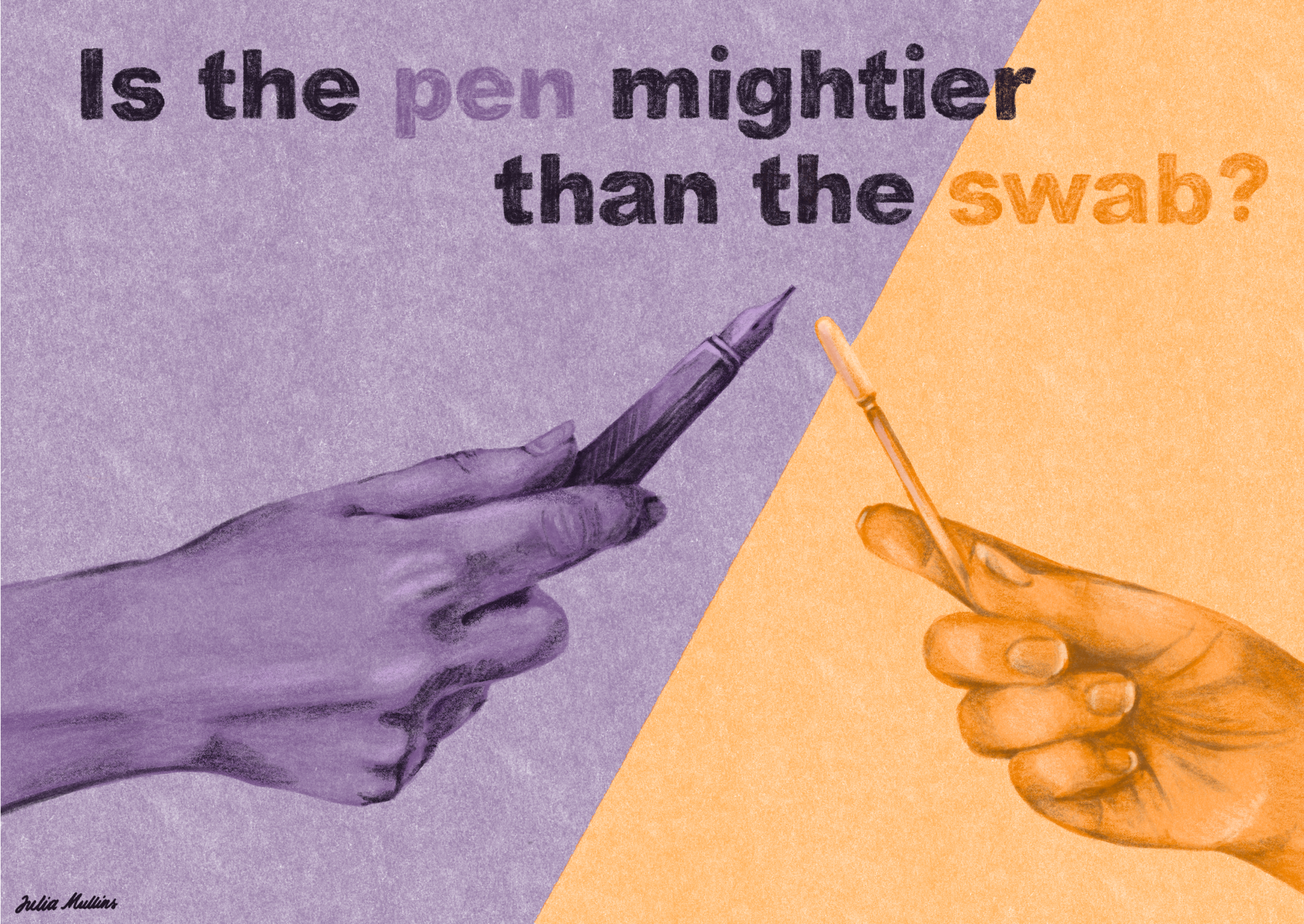
Featured Illustration: Julia Mullins / Epigram
Resources for those affected by sexual assault
At Epigram, we stand with survivors and everyone affected by sexual violence. Being able to access support is vital, but it can feel daunting if you are already struggling and have no idea where to go to get the help you need. Here’s a list of resources available to anyone who has been affected by sexual violence.
Within the University
You can find the university's resources, as well as make a report if you have been assaulted, here.
In the Wider Community
The best place to go if you need support related to sexual abuse is your local SARC, which, in Bristol, is the Bridge.
They provide specialist care to everyone, including men, women, LGBT+ people, under-18s, and anyone else who needs it. They can offer emotional, medical, or practical support, including counselling or professionally done forensic medical examinations. The Bridge is run by the NHS, so you will not need to pay for your care.
They can also provide emergency contraception or help you anonymously report to the police.
You can discover more about exactly what is available at the Bridge on their website here.
If you want to help the Bridge continue their vital work, you can donate here.
Words by Nel Roden, research by Nel Roden & Will White