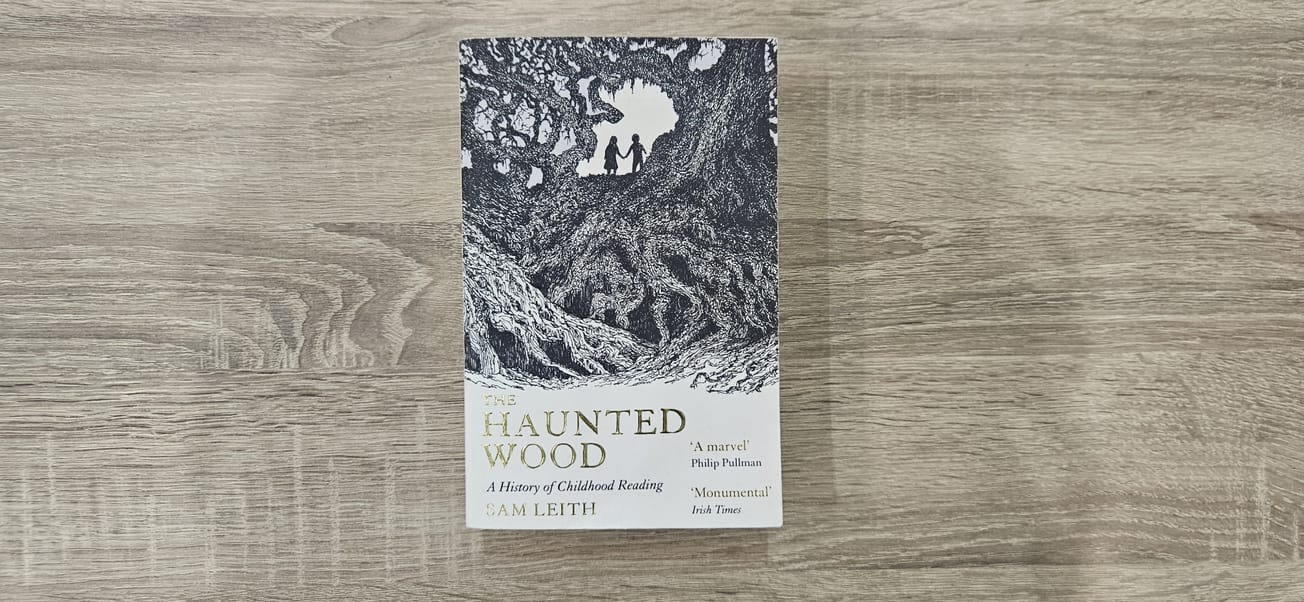
Tom Forbes talks to Sam Leith in his North London home about his new book, the changing world of journalism and our relationship with literature. Sam Leith is literary editor of the Spectator, bestselling author, host of the Spectator's book club podcast, and former judge of the Man Booker Prize and the Forward Prize amongst others. His new paperback, The Haunted Wood: A History of Childhood Reading, is a tour de force of children's literature from the ancient world to Harry Potter.
By any metric Sam Leith has enjoyed an extraordinarily diverse practice in journalism for over 30 years. He believes coming from a family of journalists encouraged him to follow suit as he explains, ‘It was kind of in the blood’.
Sam Leith claims ‘ever since I was teeny tiny, the thing I've liked most of all was reading books and talking about them’. It was a letter in 1992 written straight out of school that gave him his first headstart with the Literary Review, then edited by Auberon Waugh. ‘I had the middle class cliche of the gap year and so I wrote off to various newspapers and magazines. The only one that bothered to write back was the Literary Review - I got a personal letter from Auberon Waugh, who was kind of a big deal to me at the time, who told me ‘we have no money of any description; would you be happy to work for no wages?’. As an ‘office boy’, Leith ‘caught’ a glimpse of a world of journalism that was coming to an end; long, boozy lunches, being sent on errands to Fortnum and Mason, outrageous personalities, and writers being paid in claret. He explains the world of journalism has ‘changed an absolute ton. In the 50s, 60s, and 70s there was a ton of money in journalism and newspapers were enormously well-resourced. Journalists flew racehorses over the Atlantic on expenses and drinking at lunch was incredibly normal’.
‘Regional newspapers are now on their arse’ and London house prices mean that Tarquins and Jemima's are the only ones able to enter journalism’
The perception of journalism as a profession earmarked for the privileged is not entirely unjustified, he admitted, as an Oxford educated Old Etonian. ‘I had an immensely privileged education. My grandfather had worked for Peter McKay which is why he was probably pre-disposed to giving me a chance.’ Leith was aware of his privilege and remembers ‘saying to Mike Malloy that’ he felt he ‘was only there because of nepotism’, to which Malloy responded, ‘don't apologise; nepotism only opens the first door pal.’ Leith believes ‘the problem of privilege has gotten worse’ with his grandfather and McKay able to ‘establish themselves in local newspapers’ in Scotland before coming to London. This is no longer the case, ‘regional newspapers are now on their arse’ and London house prices mean that ‘Tarquins and Jemima’s are the only ones able to enter journalism.’

Leith's most recent book, The Haunted Wood is partly an elegy to the power and influence childhood reading can have on the rest of one's life. ‘I feel about the books you read in childhood the same as the music you listen to as a teenager’. As we grow up, our relationship to literature changes. Leith explains ‘Rereading children’s literature’ as an adult ‘does hit differently.’ He realised that many books contained ‘racist or misogynistic’ elements that we missed as children. He adds that re-reading books he had read as a kid made him realise that there was something in there for both the adult in him and the child.
‘The idea that our modern societies are corrupting children is a mental frame of very long standing, and our generation's panic is smartphones and screens’
Part of Leith’s theory on children's literature are evolving perspectives on the nature of childhood, and the distinction between romantic and puritan views. Where are we now, then, with the series Adolescence seeming to present a revival of the puritan fear of dark and malevolent forces? ‘Most ideas of childhood innocence serve an adult need. We now think that social media and the stuff on your smartphones is satan, and the threat of evil contaminating an ideal childhood. But there have been moral panics about children forever. Jamie Bulger in the 90s was a kid who was abducted by a couple of older children who killed him and there was a feral child panic. Enid Blyton had this whole thing that children weren't reading anymore and swearing because of television. The idea that our modern societies are corrupting children is a mental frame of very long standing, and our generation's panic is smartphones and screens.’

Nevertheless, as a father of three children, Leith expressed some trepidation about the future. ‘My children don't read as voraciously as I did, because they’re less bored. But the moral panics of the past haven't born out; television didn’t kill reading, radio didn’t kill reading. Plato thought that writing would kill thinking, which didn't happen. It is a threat in quite a different way, though, in that it mines attention in a very aggressive way. Telly used to be quite boring and there only used to be a few things on. We have something that is brilliantly engineered to change our dopamine circuits. They are horribly entertaining, and more entertaining than anything else. Reading is a slow food and we do at our peril underestimate the attractions of TikTok over reading a book’. ‘Lots of people do complain that young people can't concentrate on anything for more than seven seconds. But a novel which your generation took up was A Little Life by Hanya Yanagihara, which is about 800 pages long, but so melodramatic that you burn through it as though it were only 200.’
The popularity of short-form content has, in Leith’s view, put ‘the serious stuff’ at risk. In the era of 10 second clips of political ripostes, he was unsure as to how media will adapt in the long run.

As for his advice for young aspiring journalists, Leith was frank. ‘When people your age say they want to go into journalism I say ‘don't.’ I just about managed to establish myself before everything went to shit. It’s a grim vista really. Write some features, write some columns, do some interviewing; if you're agile, if you're quick and you're prepared not to stand too much on your dignity you stand a chance of prospering, but it's hard’. ‘I kind of hate AI and everything about it. As an author I don't like the fact that something which is trying to replace my profession is trying to do so by stealing my stuff in the first place and wouldn't exist without it’. ‘It's pretty corrosive to my industry.’
 Alex Boersma
In spite of the increasing hostility towards arts degrees from some corners of the right, Leith insisted that his university education in English literature was indispensable for his future career as a journalist and for his life more broadly. He exclaims ‘university had a huge influence on me personally. The tools I learnt for literary criticism read across for the middle brow book reviewing I'm doing now. A lot of people think being a fiction critic is easy. But a good fiction critic does more than simply write a synopsis of a book and judge whether they liked or didn't like it. You're trying to figure out what problems a book is trying to solve and understand whether it's successful in doing so. And without university I wouldn't have had three years to read a fair bit of the canon’. ‘It was three years of doing what students do, which is running around drinking, falling in and out of love, and having dramas, which is lovely, in my opinion, and a great way to spend time. There are lots of arguments like; ‘what's the point of an arts degree,’ ‘should everyone pay for middle-class students to read Yeats and spend time drinking at the college bar.’ ‘But on the whole I'm very pro-universities as engines and repositories of all things which are important and useful to humanity in ways that are tricky to quantify.’
Feature image: Epigram/ Tom Forbes
Have you read any of Sam Leith's work?