By Chrissy Flannery, Second Year, Film and Television
‘And all shall be well, and all shall be well, and all manner of things shall be well’.
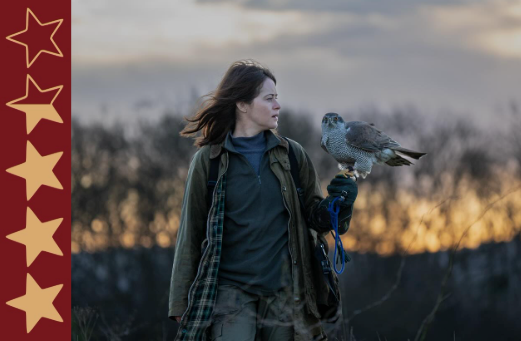
H is for Hawk, based on Helen Macdonald’s 2014 memoir of the same name, directed by Philippa Lowthorpe, is lovely and British, full with moments of realness, humour and tenderness, and presents a heartfelt portrayal of grief and redemption.
Admittedly, this is probably not the kind of film I would normally rush to go and see, and entering the cinema at 4pm on a Sunday, I couldn’t help but feeling like the odd one out, being quite literally the only person under 70 there. Yet, I have to say I was pleasantly refreshed by the heart which this film had, and really enjoyed it, despite feeling like I maybe wasn’t part of the intended demographic.
Claire Foy gives a wholly authentic performance as Helen Macdonald, a fellow at Jesus College, Cambridge in 2007, who decides to adopt and train goshawk to cope with the unexpected loss of her father, renowned photographer Alisdair Macdonald (played by Brendan Gleeson).
The cinematography of the film is definitely one of its strongest elements, beautifully capturing the English countryside, and showcasing the gorgeous architecture of Cambridge in the swooping overhead camera movements as we follow Macdonald and her students through the city.
In a scene near the beginning of the film, Macdonald arrives at a bridge to collect her hawk, in a situation which feels strangely ‘like a drug deal’. Macdonald is introduced to the bird, which violently flaps as it is lifted from the car boot, and, though unruly, we can see that Macdonald is immediately in love with this hawk.
However, the trainer then unexpectedly tells her he has made a mistake; that this hawk has already been sold, and he instead goes to retrieve another from its cage. Macdonald immediately panics, realising as soon as she meets the second hawk (who is considerably more docile) that it is not meant for her. ‘Sorry, but, that’s not my hawk’, she says, and, after some persuasion, the trainer reluctantly agrees to give her the first one. It was at this moment a memory was unearthed, and I realised I had actually studied this extract in Macdonald’s memoir years ago, for my English Language GCSE.

We then watch as Macdonald begins to train the bird, who is sweetly named Mabel, (derived in the Latin word for ‘lovable’), making many attempts in vain to feed her and tentatively showing her around the new environment. It is clear that Foy has actually learned to train the bird herself, making the scenes between her and Mabel particularly authentic. The bird must sometimes wear a hood over its eyes and ears, to protect her from outside stimuli, as Macdonald explains to her friend (played by Denis Gough) that the nerves in the bird’s eyes and ears are directly linked to its muscles, meaning she literally ‘reacts before she thinks’ (a line that feels definitely to be a metaphor for Macdonald herself).
The union between Macdonald and Mabel strengthens as she takes her out hunting in the countryside, at one point accidentally wiping the blood from a rabbit which Mabel has killed onto her forehead, an act which seems to symbolise a kind of biblical bond between the two.
At the very heart of the film is grief, the journey of it, the ways we cope with it. Macdonald is left paralysed by the loss of her father, and we watch as she deteriorates, both her a Mabel spiralling into recluse and squalor. As I watched the film, I was sure the bird was representative of Macdonald in some way, but how, specifically, I was unsure. Macdonald did not seem to embody a violent bird, she was not hunting or aggressively catching prey.
 Charles Hubbard
In a talk Macdonald gives at the university about her experiences training Mabel, she is heckled by students who ask how she can possibly ‘kill for fun’ (being a vegetarian, I can empathise with both sides of this argument). Macdonald responds that it is not fun, but Mabel is literally designed to kill, with her hooked talons meant for catching pray, her whiskers for catching blood and allowing it to dry up and fall off.
Death is everywhere; it is an element of life which is unescapable and intrinsic to life. Mabel’s very nature is to hunt, and this ubiquity of death is what allows Macdonald to ultimately come to terms with the necessity of loss.
Ultimately, it is a beautiful film, and, although I perhaps won’t be recommending it to my friends, I will definitely undoubtably be recommending it to my parents.
Featured Image: Instagram @SaheenBaigCasting | Star Illustration: Epigram / Sophia Izwa
What did you think of H is for Hawk?