By Miles Gilroy, Senior Print Editor
On January 22, a team of scientists from the University of Manchester, in collaboration with the University of Bristol and the University of Melbourne, published a study in the Nature journal Scientific Reports. This study posited the notion that, despite previous beliefs, prehistoric kangaroos may have been able to hop. I know, big news.
These days, the largest hopping animal is the red kangaroo, weighing in at around 90kg. Prehistoric kangaroos, on the other hand, were massive. With weights over twice those of red kangaroos, some even managed to reach 250kg - the equivalent of 50 domestic cats! It is for this reason that, for many years, researchers believed these creatures to be unable to hop. In fact, earlier studies suggested that hopping would be mechanically impossible over 150kg.
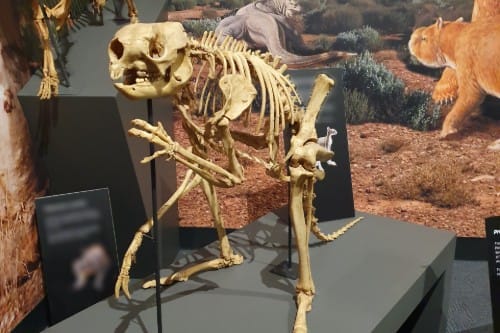
However, this conclusion was largely formulated by simply scaling up modern kangaroos - a method deemed unsuitable by the team from Manchester, Bristol, and Melbourne. The new method pairs knowledge of modern kangaroos with evidence from fossils of prehistoric ones since scaling alone may mean ‘we miss crucial anatomical differences,’ according to lead researcher Megan Jones, Postgraduate Researcher at the University of Manchester.
Megan also says their findings show that prehistoric kangaroos were ‘built differently’ to modern ones which ‘helped them manage their enormous size.’
The team investigated two potential limiting factors: the strength of the foot bones and the ability of the ankle to anchor the powerful tendons required to drive a hop. They found that giant kangaroos had shorter, thicker foot bones, capable of withstanding larger landing forces, while their heel bones were broad enough to support much thicker ankle tendons.

But, possessing the mechanical ability to hop doesn’t necessarily mean these giants would have been jumping all over the place. ‘Thicker tendons are safer, but they store less elastic energy,’ explained Dr Katrina Jones, Royal Society Research Fellow at the University of Bristol. So, due to their size, giant kangaroos would have been ‘slower and less efficient hoppers’ than their modern counterparts. They would have been ‘better suited to short bursts of movement, rather than long-distance travel.’
However, their hopping ability would have still come in handy, despite its efficiency pitfalls. ‘These animals probably used their hopping ability to cross rough ground quickly or to escape danger.’ Hopping would have been useful in a pinch, but it is more likely that giant kangaroos had a broad ‘movement repertoire,’ potentially including walking upright or even on all fours.
So if - for whatever reason - you find yourself being chased by a kangaroo, just be grateful that it’s not twice the size and running on all fours.
Featured image: Epigram/Corin Hadley (illustration); Unsplash/Dan Meyers (background)