By Katy Bright, Second year English Literature
Romantic literature has been reshaped. There is no denying that sometimes the most thrilling romances are the forbidden, the sexually driven and the dramatic. The traditional romance novel is not everyone’s pick, but I'm here to explore why that is and what has changed.
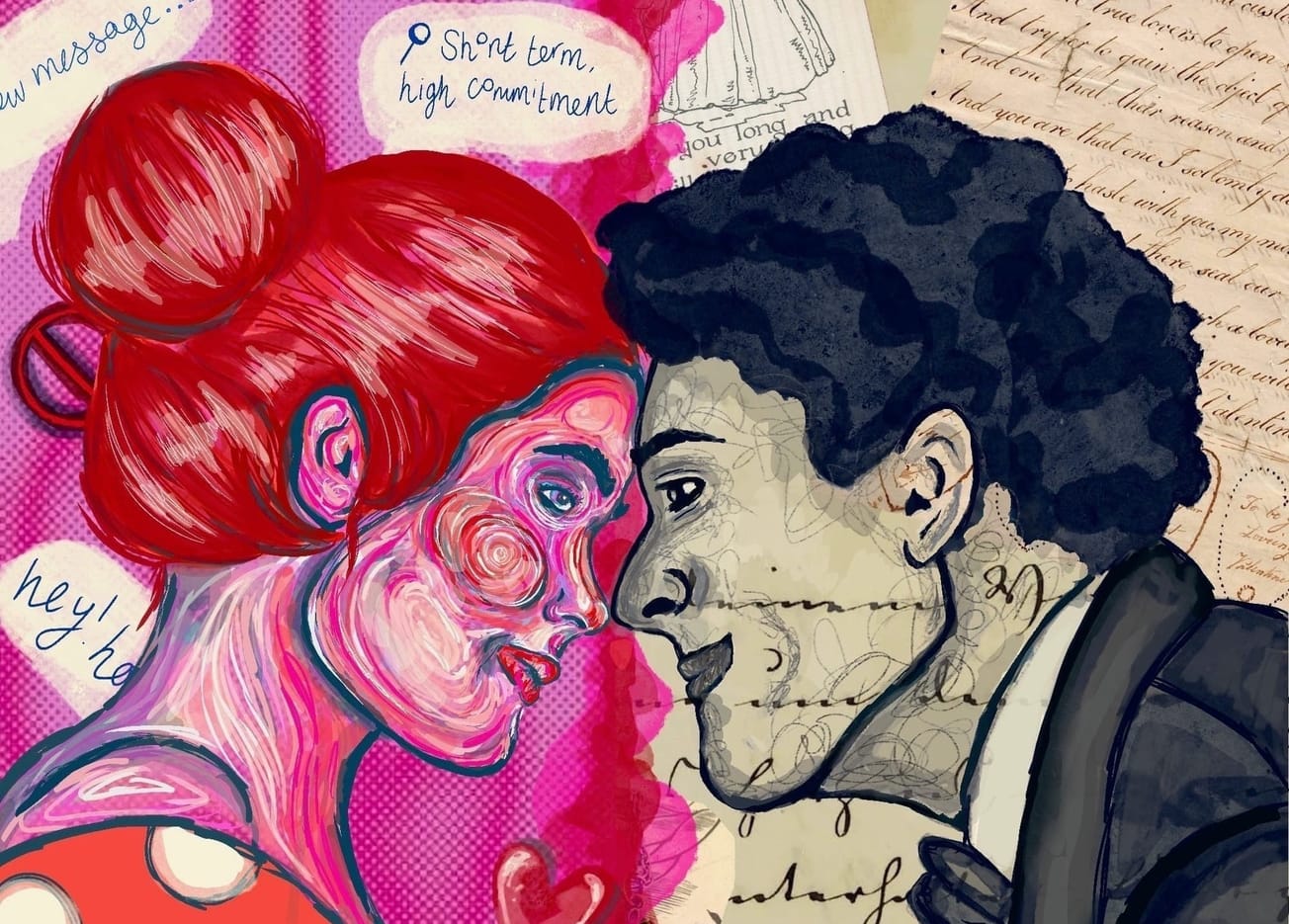
Romance narratives have not necessarily lost their value, but the way we consume them has changed. Modern readers, due to the influx of social media led short form content through TikTok and Instagram, we have come to expect and desire instant gratification. We get bored and distracted more easily than previous readers did. Hence the slow burn and the patient waiting for a lover seems somewhat tedious to us now. This constant and fast paced stimulation clashes with the pace of traditional romance novels. Love and romance have not disappeared, they are just being engaged with in a new way that modern scrollers can handle.

Romance has become curated. It is equally as important to present your relationship positively on social media as it is in real life. Think about dating apps. Hinge, an app ‘designed to be deleted’ values the way you market and profile yourself, and that is the way that you find a connection. Tinder, which reached its peak popularity in 2023, is a simple process of swiping left or swiping right. This surely isn’t a surprise. Our need for stimulation and instant connection, because of the social media and internet dependency of our generation, makes this ‘speed dating’ ideal. There is no need to get up off the sofa, you can have simple back and forth conversations to keep the mind occupied. If replies get slow or dry, you can pass or ghost them.
Perhaps due to romance in real life often being nothing like the movies, the cliches have become unrealistic. However, many Romance novels preserve this traditional vision of love. From Austen’s Pride and Prejudice to McQuiston’s Red, White and Royal Blue. As beautiful and idyllic as this is, it often makes modern readers feel disassociated as they are unable to relate. Novels depicting love, marriage and deep connection are alien to us. We are told we are naïve to expect grand gestures, travelling long distances. It’s sad, because it seems like self-consciousness has taken over. It would be embarrassing to expect this cliché, and it is not met, so it seems safer to not expect it in the first place.

These predictable plots just seem unpredictable in reality. Every romance novel seems to follow one of these traditional tropes, which completely goes against the messiness and lack of clarity in modern relationships. Due to the sheer popularity of the romance novel, these tropes have become saturated. One could read the blurb, look at the front cover or even read the first sentence and be able to anticipate the story itself. Social media has had a part to play in this with the revival of ‘BookTok’ bringing all this vocabulary into casual conversation. The magic of these romances is lost.
According to Metro, the most watched Netflix series’ in 2025 were Squid Games and Adolescence, which certainly do not depict budding romance. However, if we go back to 2021, Bridgerton thrived as the most popular. Perhaps its diversity, shifting a traditional romance into something culturally liberating, is what contemporary audiences want.

BookRiot have suggested that there are rational reasons behind this shift. The virality of books on social media platforms have been able to cater directly towards audiences. The way a book is marketed is not valued anymore in its front cover but the way the author or a collective group talk about the novel online. Furthermore, these classical novels raise the question of diversity. The genre commonly centres around a heterosexual relationship between two white individuals, a male and a female, and that is not telling of our culturally diverse standing now.
Romance is not dead, though. Traditional romance might be, but love will always prevail. Contemporary tales of fantasy, mystery and thriller are the new way for romance to thrive. Over the past five years, there has been a steady decline in the publication of these traditional romances. Authors are encouraged to go in a different direction, to fit in with the moving times.
 Emma Coleman
In 2025, ‘Romantasy’, a heated blend of the otherworldly with sexual tension, was one of the most popular book genres. It is not based on courtly love or gentlemen saving their damsels, but on passion, lust and fantasy. Maybe it is unobtainable love, not because we cannot get it but because it is unhuman, that readers crave. For example, Silver & Blood by Jessie Mihalik explores a desperate mage falling in love with a mysterious and powerful man. Further, Jaclyn Rodriguez’s A Vow in Vengeance is a dark academia romance fantasy which follows a mortal seeking revenge and finding love along the way. Traditional novels make us feel bad about ourselves and our situation, because let’s face it, we aren’t debutantes. But by telling a story of something magical and mystical, we cannot compare ourselves to it, and that is the type of romance novel that we crave.
We cannot expect the traditional to thrive in a world where the traditional no longer exists. There is a move towards something contemporary, something new, fast-paced and otherworldly that might just bring back the resurgence of romance.
Feature Image: Epigram/ Imogen Lewis
Do you still reach for romance novels?