By Ish Kumar, Second Year, Anthropology
The University of Bristol was initially a small University College. After John Percival was influenced by a Victorian belief that higher education could serve the city, early supporters envisioned an institute to support working people, and contribute to social and industrial progress. Who would have thought that a small meeting, in the beloved Victoria Rooms, to promote a ‘School of Science and Literature for the West of England’, would lead to one of the most renowned academic institutions in the world?
University College opened in 1876 with just seven staff and fifteen subjects. Despite its small size, ambition was not lacking as almost 50% of its first 337 students were women, a pioneering moment for women’s education. Later, in 1833, the Bristol Medical School was established, and in 1894, the Merchant Venturers’ Technical College was added.
In 1909, King Edward VII approved the royal charter for official university status. This dramatically expanded the size, scope, research, and renown of the University of Bristol, which, to this day, ranks highly on university league tables. In many ways, this is a genuine success story: academic knowledge is no longer the preserve of a few, more campuses have opened, relatively new subjects such as computer science now shape our understanding of the world. Bristol has made phenomenal impacts on discovery, research and the progression of knowledge with links to thirteen Nobel Prize winners and several notable alumni, including, Sir Winston Churchill, Dorothy Hodgkin, Sir William Ramsay and more.
But, has this growth come at a cost?
Universities nationwide have succumbed to the growing trend of neoliberalisation, a gradual transformation from public institutions into competitive, market-oriented organisations. The introduction of tuition fees in 1998 and their rise to above £9000 per year has fundamentally altered the relationship between students and the university. This shift has brought several improvements, such as a greater attention to teaching quality and clearer accountability, however it has radically hollowed out trust. Education has become something to be ‘delivered’ rather than co-created.
Alongside this neoliberalisation spike is an explosion of academic bureaucracy. Increasing amounts of time are spent on audits, frameworks and performance indicators, to the detriment of time spent on critical work, teaching, and mentoring.
However, it would be wrong to paint the last 150 years as a story of decline when impressive growth has occurred. International students have brought along intellectual, cultural, and political richness. Conversations surrounding race, gender, disability and mental health, once deemed marginal or taboo, are now encouraged and central to university life.
Bristol has always maintained a reputation for its progressive outlook, as evident through its efforts towards equal education. Bristol’s Helen Wodehouse (1919) and Winifred Shapland (1931) were appointed the first female chair and first woman registrar of any British university.
However, inequalities persist today. Due to an historic underrepresentation of working-class students, the University of Bristol has been regarded as ‘elitist’ and consequently the 93% club was formed in 2016. A new admissions policy has seen increasing state-school admissions (now around 75% of undergraduates), and the university acknowledges that there is more to do in this area, but for some Bristol retains a ‘posh’ connotation.
Moreover, many of the founding funds have connections to the transatlantic slave trade. The Reparative Futures programme, along with the change of the logo, originally including a dolphin, infamous slave trader Edward Colston’s favourite animal, is a clear attempt to take accountability. The university is also keen to emphasise that Colston died ‘nearly 200 years before [the University of Bristol] was founded.’
Like universities nationwide, Bristol is not immune to tragic and rare cases of student suicide. Instead of shying from this, Bristol has a range of support mechanisms available to students and is constantly looking at ways to develop and improve services to support those who need help, including an increase in specialist mental health provision, the introduction of self-bookable appointments and improved information sharing.
 Julia Mullins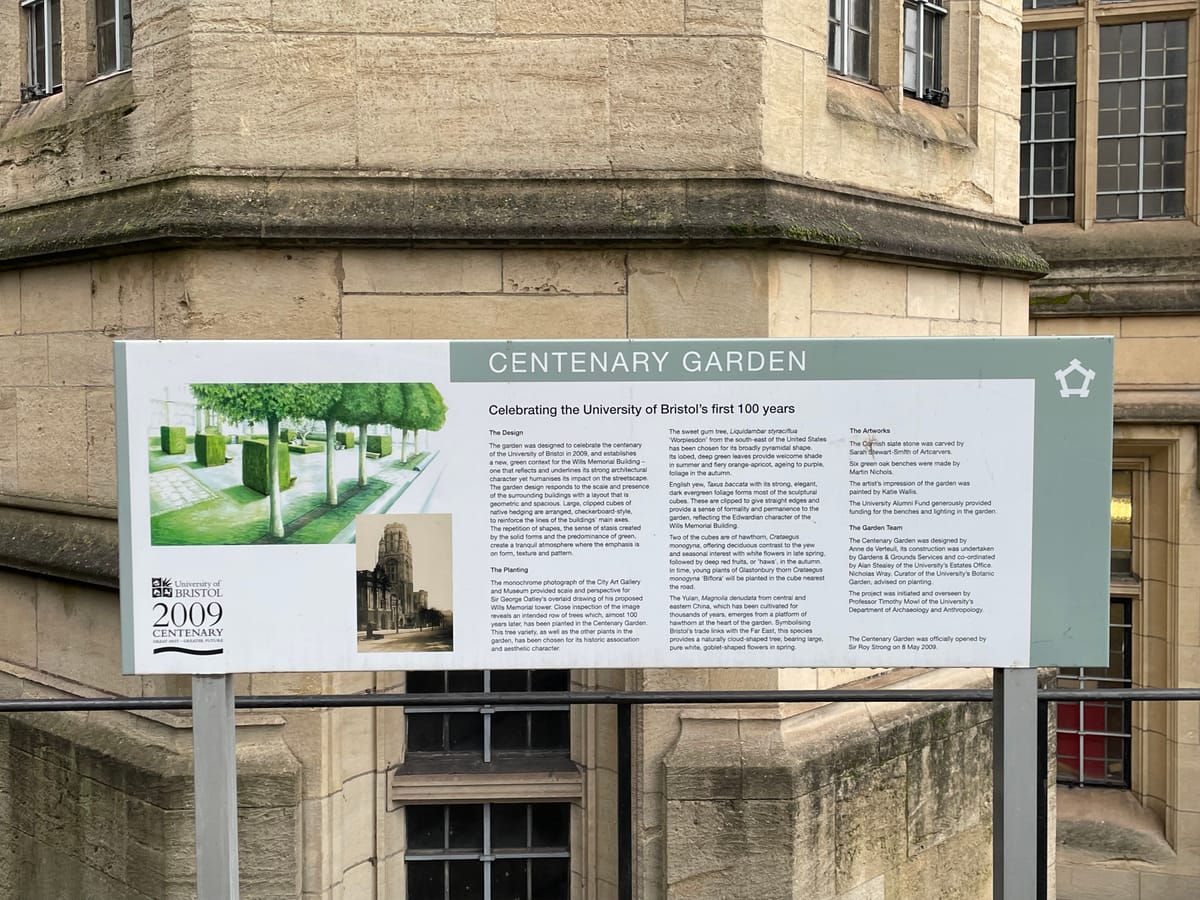
 Brontë Harris
Much has changed and undoubtedly much change is to come. Picturing the University in 2176 is necessarily speculative. Some challenges include climate change, and what the rise of AI means for questions of authorship.
Another question is whether the university can retain its sense of purpose beyond survival and prestige. As the University of Bristol reaches its 150th birthday, that dream of a small few in 1876 remains unfinished, and as their successors we owe it to them to pursue knowledge whilst questioning and calling for change.
Featured image: Epigram / Hannah Corcoran
What will the University of Bristol be like in 150 years from now?