By Crystal Calo, Second Year, Politics and International Relations
Elections are a go to mechanism used across society to measure if a candidate is fit for leadership. Recently, the elections of Trump and Johnson has raised questions on voter judgement. However, there is a viable explanation for this that extends further than just the ballot box. This can be attributed to how humans respond to the presence of certain personality traits. Robert Redford's 1972 classic The Candidate, explains how the power of a charisma can give you leverage over others in any setting, especially university.
The Candidate follows young lawyer Bill McKay, who campaigns to become the senator for the state of California. He is motivated to push personal incentives. McKay is initially moulded into a politically neutral and socially digestible public figure by his campaign manager, Marvin Lucas. However, upon learning he was predicted to lose, McKay changes the focus of his campaign. He later prioritises delivering emotive speeches, on criticising the establishment, over modifying his manifesto. The film closes with McKay unexpectedly winning his election.
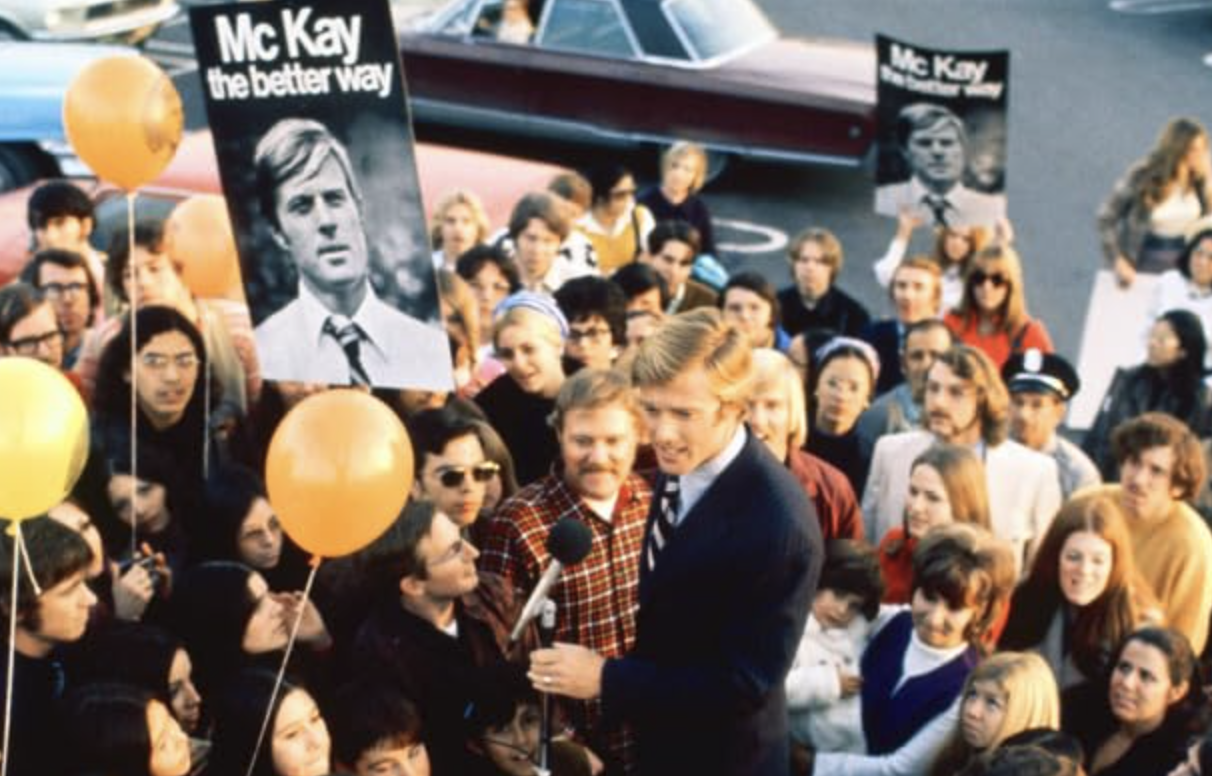
The Candidate was never intended to focus on political substance but on human behavior. The early 1970s was rife with political turmoil in the US. The 1970 Kent State shootings, the 1972 Watergate scandal and the Leak of the Pentagon papers had contributed to a Machiavellian interpretation of politicians. Redford was criticised by a minority that much of the potential political substance that could have been integrated in the film was compromised for style.
However, I interpret the hollowness of The Candidate as well intentioned. The film reflects how emotive campaigning styles are successful- and shouldn’t be. McKay, admitting to not voting from the mid sixties, is an illegible candidate. Nonetheless, this shows that how you present yourself, is equally if not more important than the message you wish to deliver. This can be already seen interpersonally as listeners are more attentive to body cues than words in conversation.
In the film's form, Redford ensures that McKays personability compensates for his lack of political knowledge. The frequent camera close ups on McKays face throughout the film mean we are more fixated on his mannerisms and facial expressions rather than the content of his words. In our discomfort, we are forced to part from our rationale and acknowledge McKay's persona.
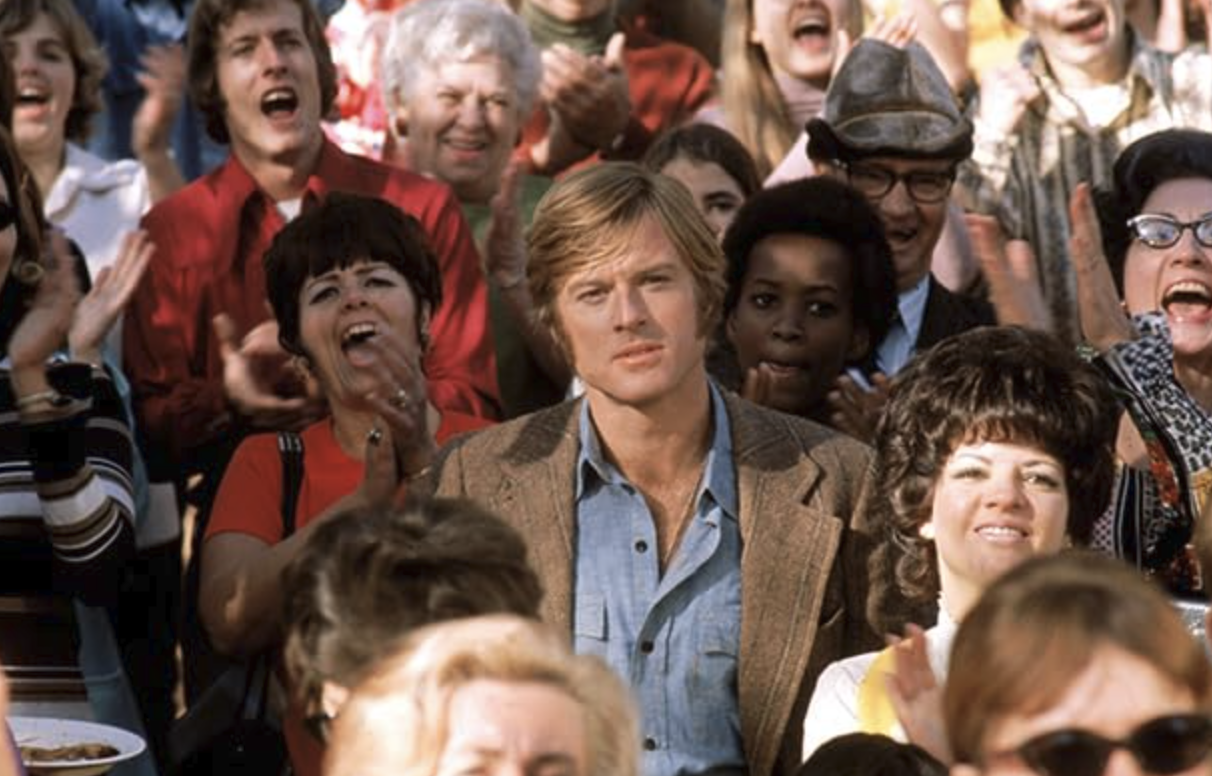
Camera angling and lighting is used to emphasise McKay's overwhelming mediocrity. In scenes where Mckay is among his campaign team, shots of his face are brief in the face of his support. Showing how his image is not independently curated. Dull lighting used during his speeches undermines his perception as divine or talented. Despite Mckay having a strong hold on others as a revolutionary of the Californian people. Redford reminds us McKay is not special. This ironically shows that anyone can cultivate charisma, and that McKay does not hold an inherent power.
Sociological theory supports the cruciality of charisma in McKays success.Max Weber coined the term ‘Charismatic authority.’ This is described as collective submission to a political figure because that figure has portrayed themself as special. This is a more interpersonal method of gaining power as it exploits people’s reward of good social skills to overlook a leader's competence. Studies support charisma's success as a 2016 study showed that leaders are more likely to be trusted if they were charismatic .
Charisma is a central part of McKay’s campaign. As the election looms, McKay finds himself addressing crowds rather than touching individuals at small gatherings. McKay’s team maximises larger spaces as charisma is only powerful when others validate the person. This looks like a tactic to use emotional tools as more effective than arguments embedded in logic. However, emphasis on this campaign shows that emotive uses of power are more sensitive and have to be maintained. McKay transitions from being a flawed individual to the public to a flawless product that is consumed.
The Candidate is not an inspirational story of a passionate political figure gaining power for public good. More accurately, it is a fictional tale that draws on the amount humans need for excitement, novelty and connection that leads them to naively place trust in those who know how to look like they care.
‘The American people realise that we’re in this together and we sink or swim together,’ is a clear example of Mckay creating a false sense of intimacy in individualistic America. However, the state isn't the only place that is self-serving.
 Anna Dodd
University, and any social environment takes precedence in rewarding perceived strength of character. I am not trying to scout future politicians. I am drawing attention to the fact every environment holds a political basis.
Appealing to people around you can be as simple as open body language and good eye contact. As shown as McKay, we can all take benefits from presenting ourselves with confidence, warmth and integrity.
Featured Image: Epigram / Romina Treviño
Voting for the Bristol SU elections begin on the 9th March, you can cast your vote here.