
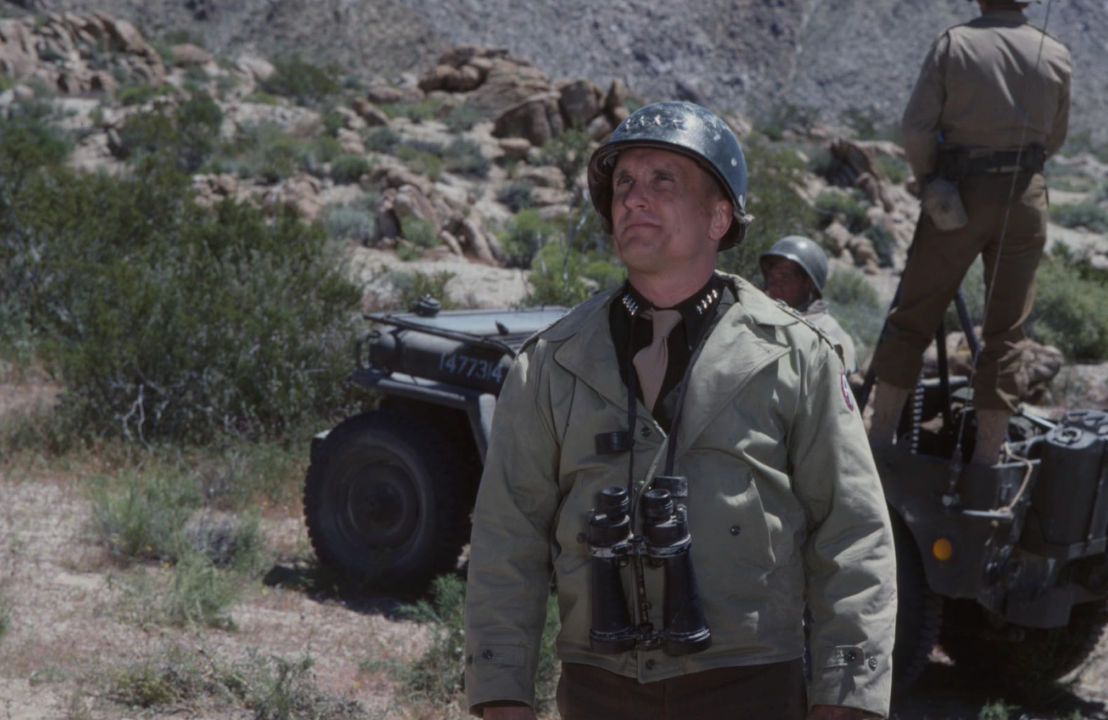
By Charles Hubbard, Second Year, Theatre and Performance
Robert Duvall, who died last week aged 95, was always somewhat of an outlier in the pantheon of great New Hollywood leading men. He wasn’t pretty like Robert Redford or Warren Beatty or cool like Paul Newman and Steve McQueen. He didn’t have the magnetic, vibrating anger of a Jack Nicholson or a Gene Hackman or the unwieldy reputation of Al Pacino or Robert De Niro, both of whom starred alongside him in The Godfather Part II (1974).
In fact, it was always Duvall’s lack of a defined movie star persona that made him distinctive, and of course catnip to directors who wanted someone with leading man talent without leading man baggage. He was certainly always chameleonic but never quite in the headline-grabbing fashion of Daniel Day-Lewis and Christian Bale, both of whom have cited him as one of their favourite actors. It’s perhaps this tricky defying of categorisation that meant that, like Pacino, it took Duvall twenty years after his astonishing breakout turn in To Kill a Mockingbird (1962) to finally get a long-overdue Academy Award, for his characteristically sensitive and understated performance in Bruce Beresford’s Tender Mercies (1983).
Despite forever getting far less of the limelight than he deserved, Duvall outlasted all of his contemporaries when it came to giving great performances. He never retired, acting as recently as 2022 (in the Adam Sandler-starring basketball drama Hustle) and was always able to avoid becoming a tired caricature of himself in the way that Pacino, De Niro and Nicholson eventually fell into. It’s high time we all acknowledged Duvall for the titan of the form he was in all his roles, both big and small.
Perhaps the most important and revealing element of Duvall’s career is that he came out of repertory theatre, most notably Bellport’s Gateway Playhouse, where he appeared in such classic plays as The Cat and the Canary (1955), Witness for the Prosecution (1957) and A View from a Bridge (also 1957), mostly in smaller, ensemble-based roles. While other more infamous actors are often prone to showboating, it’s easy to see Duvall’s basis in this more egalitarian form of theatre when it comes to his mastery of the supporting part.
While never less than captivating any time he was given top billing on the marque, such as the aforementioned Tender Mercies, George Lucas’ bewitchingly strange THX1138 (1971) or his onstage turn as Stanley Kowalski in the Gateway’s 1959 production of Tennessee William’s A Streetcar Named Desire, Duvall’s true brilliance always lay in his less showy work out of the spotlight.
This was first showcased in celluloid in Robert Mulligan’s 1962 adaptation of To Kill a Mockingbird, in which Duvall played the role of Boo Radley - the reclusive and misunderstood neighbour of the Finch family. Whilst only appearing in the last fifteen minutes of the film, Duvall is quietly devastating, effortlessly translating the nuances of Harper Lee’s prose into bone-deep emotions in a way that not even Gregory Peck, the film’s lead, could quite match. In 1962, Duvall’s strikingly blank phase emerging from the shadows of Russell Harlan’s gorgeous black-and-white photography was the way that most audiences experienced the actor for the first time. However, it would not be the last.
Next came The Godfather (1972). Whenever I watch Francis Ford Coppola’s peerless masterpiece, as I do almost twice a year, it is always Duvall’s performance that I appreciate the most. He doesn’t have the violent outbursts of James Caan’s Sonny. Or the I-can’t-believe-it’s-him physical transformation of Marlon Brando’s Vito. Or the tragic narrative arc of Al Pacino’s Michael. However, Duvall’s portrayal of Tom Hagen, Don Corleone’s consigliere, is never less than jaw-dropping, whether it be his quiet intimidation to the histrionics of John Marley’s pedophilic film producer Jack Woltz or having to tell his surrogate father that his son has been killed.
It is one of the great cinematic tragedies that, due to salary disputes, Duvall refused to appear in the final entry of Coppola’s godfather tragedy. The key component of that film’s diminished legacy is the glaring absence of the final living Corleone brother as Michael’s empire of crime crumbles around him. All this is not to say that Duvall’s greatness lay only in his subtlety.
Lonesome Dove might be the best limited series ever made. Robert Duvall & Tommy Lee Jones are historically great in this series. This aired in 1989 but still holds up so well- it’s a timeless Western epic. Duvall is right in the middle of his prime here. One of the best ever. pic.twitter.com/7Ofvygyd6p
— Cinema Tweets (@CinemaTweets1) February 16, 2026
On the contrary, he could chew the scenery with the very best of them. His performance in Apocalypse Now (1979) as the surfing, cigar-chomping and cowboy hat-wearing Colonel Kilgore forms rightfully the most iconic and beloved section of what is already one of the most revered films in Hollywood history. The image of Duvall taking a strong whiff of the burning Vietnam air and declaring ‘I love the smell of napalm in the morning’ is about as great a film moment as you are ever likely to get.
It’s also notable that Duvall appears to be the only cast member of that film not to have been irreparably broken by the project. While Brando, Dennis Hooper and even Martin Sheen appear never to have recovered from the notoriously disastrous 16-month shoot in the Filipino jungle, Duvall strode right ahead with the Great Santini (1979), for which he garnered an Oscar nomination for Best Actor.
 Erin O’Connor
Duvall’s eight decade discography is so impressive that trying to sum it up in a five thousand word obituary, let alone the measly one thousand I am limited to, is a fool’s errand. I haven’t even mentioned his barn-burning performance in Sidney Lumet’s Network (1976) - one of my favourite films of all time!
Do yourself a favour and take another look at his career. There’s plenty of diamonds to be found - treasured works and buried gems alike. Last week we lost a giant of the form and one whose profound onscreen works will not soon be forgotten.
Featured Image: IMDb
What was your favourite film of Duvall's sixty-year career?

)