By Dabrowka Nowak, Third Year, English
I remember the day of Cohen’s death through the way my mother cried about him, showing me a book of his collected lyrics translated into Polish gifted by a figure from the past. I was eleven years old, unable to understand how one could be so devasted over the death of a complete stranger.
Older now, I recognise Cohen’s uniqueness in describing romantic and emotional experience with such accurate perfection that you need not your own words, he is inside your mind, he makes everyone feel heard. The death of this poet becomes specifically personal. The death of a ladies man, every lady’s man.
Cohen’s death was ‘sudden, unexpected, peaceful’. I remember these words from his manager from the time of his death. 2026 also marks 10 years since the release of You Want it Darker. ‘Unexpected’ does not apply to what we can assume Cohen’s view of his death was. ‘I’m leaving the table’, ‘Hineni, hineni, I’m ready my lord’ present an honest surrender, incredibly ‘peaceful.’ However, from a Cohen fan’s, like my mother’s perspective, how can anyone expect death from a figure so wise that they seem infinitely immortal?
On the 31st of January the Cube Microplex hosted a Leonard Cohen Karaoke Night, with his signature fedoras, guitars and a piano available on stage. I had a beautiful time, I enjoyed the collective joy and worship of this figure, the collective acknowledgement of the strangeness of a night out of singing some of the saddest songs known. Every person on stage embodied Cohen’s legacy, providing the rare opportunity to see the music live on stage.
What interested me, however, was the difference between Cohen’s meaning in my circles and outside of it.
This got me thinking. Cohen’s music to me and plenty of those close to me contains a pretentiousness I love to acknowledge fully. I went to Vienna and found the ‘lobby with 900 windows, the tree where the doves go to die’ purely because of his translation of ‘Take this Waltz.’
Many a time have my friends and I sang ‘So Long Marianne’ with a guitar and some wine, I loved the inclusion of ‘I’m Your Man’ in Secretary (2002). There is a pleasant stereotype of literature, music and movie loving young women throughout generations being swayed by Cohen’s poetic (‘Take this Waltz’, ‘Lover Lover Lover’), innocent (‘So Long Marianne’, ‘Suzanne’, ‘Hey, That’s No Way To Say Goodbye’), sexual (‘I’m Your Man’, ‘Dance me to the End of Love’) charms.
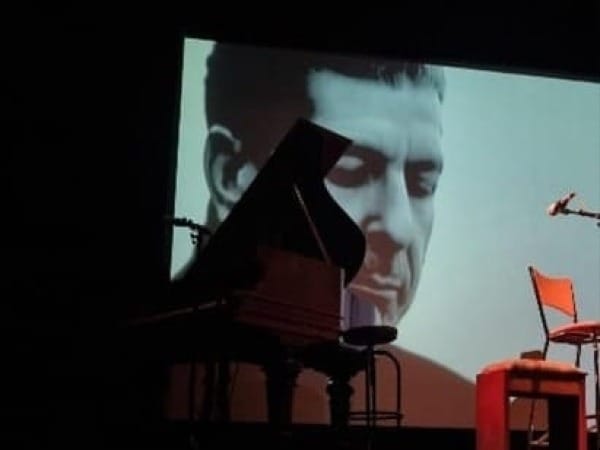
So, at the Cube, I was surprised at the lack of women managing to get through the long karaoke waiting list to dance and laugh and sing on the stage. The night was fabulous yet centred around the (incredibly talented, creative and lovely) men portraying their accurate interpretations of Cohen’s music with intense seriousness.
Leonard Cohen birthed a duality of image where aside from serious art, he is a universal girly symbol of sexuality and heartbreak, an alternative celebrity crush who romanticizes himself for you. But the reality is that he was a womanizer, a self-proclaimed ladies’ man who sang explicitly about sex acts with Janis Joplin in the Chelsea Hotel. He writes sleazy poetry, the least offensive on how ‘small breasts/are the upturned bellies/of breathing fallen sparrows.’ Who is Leonard Cohen honestly if not a man taking himself remarkably seriously on stage?
It is hard to think of a favourite artist or similar interest outside of your own perspective. Cohen, as I have outlined, is a figure for me and many others of, in full acknowledgment of ridiculousness, a poetic and musical salvation, someone to giggle about and romanticise. The event was perfect in demonstrating the tensions of reminiscence, where some wanted to dance and take the seriousness music un-seriously, and those who wish to fully and faithfully provide a continuation of legacy. Either way, what a lovely way to remember!
Cohen came to Bristol only a handful of times, playing the Hippodrome in 1974 and what is now Bristol Beacon in 1976. The impact he continues to have on a corner of the world that never diverted his path is incredible.
 Ambar Madhok
 Gabriel Lordon
It has now been nearly ten years since the death of the ladies man himself. When asked ‘do you believe in a life after this one?’ by Kari Hesthamar in 2005, Cohen replied, with laughter, ‘I hardly believe in this one!’. We can recognise Cohen as embodied romance, genre and age defining artist, but one’s who’s artistry deserves special, dramatized and fitting analysis . The lyrics of ‘Lover lover lover’ as addressed to the artist resonate: ‘I locked you in this body/I meant it as a kind of trial/ You can use it as a weapon/Or to make some woman smile’. Cohen, in a life he hardly believed, made the world smile and cry and continues to do so a decade after his passing.
We must now comprehend and commemorate ten years since his mortality was, like his manager said, ‘unexpectedly’ proven. Leonard Cohen would tell us, in his ceaseless wisdom, ‘Its just the way it changes, like the shoreline and the sea’.
Featured image: Epigram / Dabrowka NowakDo you have a favourite Cohen song?