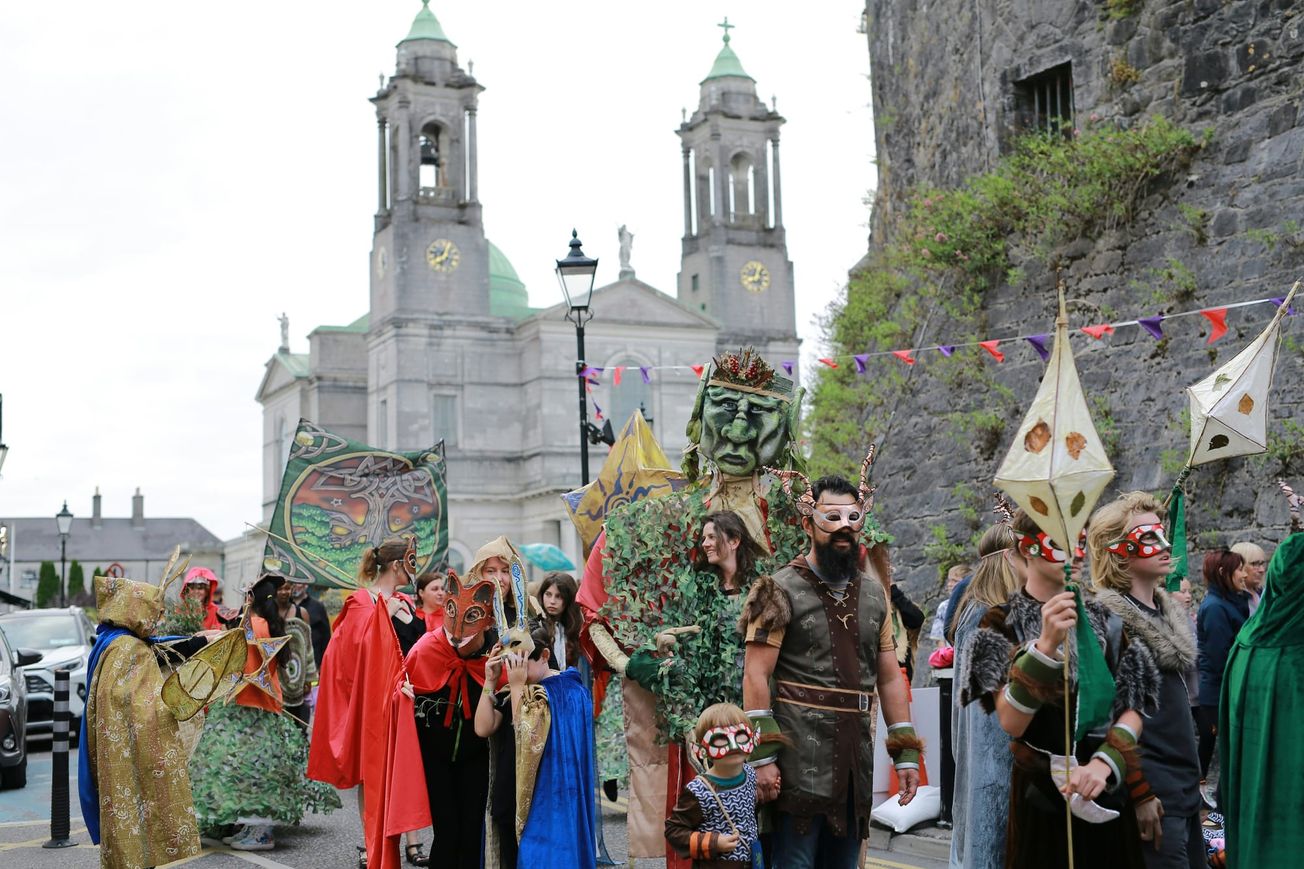
In celebration of International Women’s Day and St Patrick’s Day, it is an apt moment to revisit the powerful women who shape the landscape of Irish folklore and mythology. From formidable goddesses to legendary queens and Otherworldly figures, these stories reveal how female characters have long stood at the heart of Ireland’s mythic tradition.
The Morrígan
‘The Morrígan’ is a formidable shape-shifting goddess associated with war, fate, and fertility in Irish myth. Often depicted as transforming into a raven or crow on the battlefield, she is closely linked with prophecy and the chaos of combat. In the heroic tales of Cú Chulainn, the Morrígan repeatedly confronts the warrior, taking on various forms, including a heifer, an eel, and a she-wolf, in attempts to hinder or test him.
Beyond her fearsome presence in battle, the Morrígan was believed to possess the power to stir courage and ferocity within warriors, urging them to draw upon their inner strength in the pursuit of victory. In some traditions she is also associated with the divine lineage of the Tuatha Dé Danann, and has occasionally been linked with the primordial mother goddess Danu—the mother of The Dagda—suggesting a deeper connection between sovereignty, fertility, and the forces of war within the mythological tradition.
Brigid
Brigid (or Brigit), is one of the most revered figures in Irish mythology, associated with health, fertility, poetry, prophecy, learning, the hearth, and smithcraft. In early tradition she is described as the daughter of The Dagda, the wife of Bres, and the mother of Ruadán. Many sources also refer to her alongside two sisters, suggesting a triadic aspect to her character. Brigid embodies the creative and nurturing dimensions of femininity, representing inspiration, wisdom, and protection.
Her influence is closely linked with the Celtic festival of ‘Imbolc’, celebrated from sunrise on February 1st until sunset on the 2nd. Occurring between Winter Solstice and Spring Equinox, Imbolc marks the midpoint of the dark half of the year and signals the gradual return of Spring. Traditionally it was a hopeful festival, welcoming the promise of longer days and renewed life. The name Imbolc is often thought to derive from Old Irish terms meaning ‘in the belly’ or ‘ewe’s milk’, reflecting the season when ewes began to lactate and the agricultural year slowly stirred back into motion.
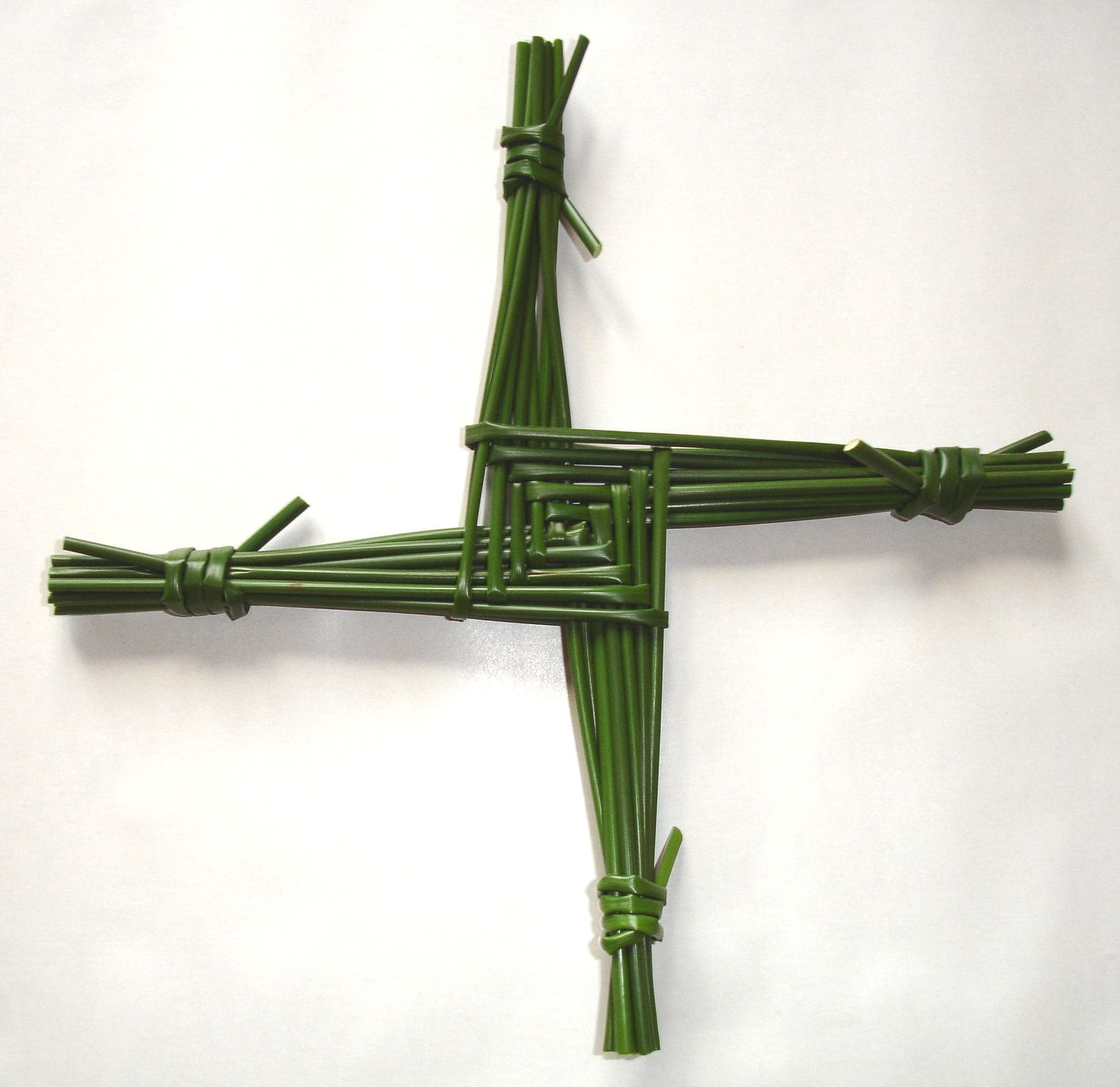
Rituals associated with Imbolc commonly included the lighting of fires and candles to symbolise the strengthening sun after the long winter months. Another enduring tradition is the weaving of the Saint Brigid's Cross from straw or rushes. These crosses were traditionally placed above doorways, windows, or in stables, where they were believed to bring protection, blessing, and good fortune to the household for the year ahead.
The Cailleach
The figure of The Cailleach is most closely associated with the southwestern counties of County Kerry and County Cork. Often called Cailleach Béara, the 'Hag of Béara', from the Gaelic word cailleach meaning an old woman or crone, she is regarded as one of the most ancient and powerful beings in Irish mythology. In many traditions she forms part of a triple goddess archetype, representing the crone alongside the maiden and the mother, and is sometimes seen as the winter counterpart of the goddess Brigid.
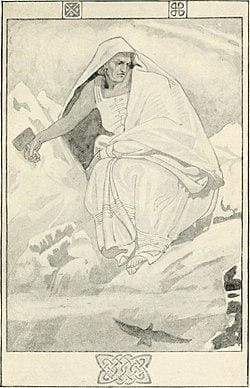
The Hag of Béara appears in legend as a formidable old woman who brings winter with her and wields great power over life, death, and the natural world. Because she was believed to control the weather and the changing seasons, communities often regarded her with a mixture of reverence and fear.
She is also linked to the creation of several striking Irish landscapes. Folklore credits her with shaping landmarks such as Hag’s Head at the Cliffs of Moher and Sliabh na Caillí ('the Hag’s Mountain'). According to legend, stones spilled from her apron as she travelled across the land, forming mountains and rocky outcrops.
As a seasonal spirit, the Cailleach is often called the 'Queen of Winter'. In some traditions she rules the darker half of the year, from Samhain on November 1 to Beltane on May 1, while Brigid presides over the fertile summer months.
Macha
In Irish mythology, Macha is a powerful and complex sovereignty figure associated with territory, fertility, and war, particularly linked to Armagh, whose Irish name, Ard Mhacha, means ‘Macha’s height’. Early texts describe several versions of her. In one tale, she appears as a mysterious Otherworldly woman (the ‘Otherworld’ referring to the realm of faeries and magical beings), who marries and brings prosperity to a farmer, who foolishly boasts about his wife’s divine strength. Hearing this, she was forced by King Conchobar mac Nessa to race his horses while heavily pregnant. She wins but collapses in labour upon the finish line, and she dies giving birth to twins. Before she perishes, she curses the men of Ulster to suffer labour pains in their greatest hour of need.
Another tradition presents Macha Mong Ruad ('Red Mane'), the only female High King in medieval Irish king lists, who defeats her male rivals and compels them to build the fortress of Emain Macha. In other sources she is counted among the daughters of Ernmas of the Tuatha Dé Danann and linked with the battle goddesses The Morrígan and Badb, reinforcing her role as a formidable divine force in Irish myth.
The Banshee
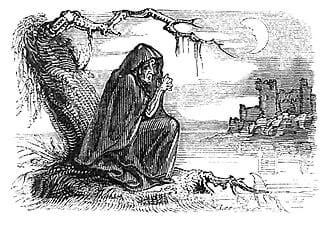
In Celtic folklore, the Banshee is often regarded as Ireland’s counterpart to the Grim Reaper. Known in Irish as the Bean Sí, meaning ‘fairy woman’ or ‘woman of the fairy mound’, she is a supernatural figure connected to the ‘Otherworld’ and the ancient fairy traditions of Ireland.
The Banshee is most commonly described as an elderly woman with long grey hair, dressed in black or dark robes, her eyes red and swollen from weeping. In some accounts, however, she may appear as a young and beautiful woman or even a spectral washerwoman, endlessly lamenting beside a river. Her presence is rarely seen directly; instead, she is known by the chilling, mournful cry that echoes through the night.
 Lydia Lewis
According to tradition, the Banshee’s piercing wail signals that a death within a household is imminent. Rather than causing the death itself, she serves as a supernatural messenger, warning families of their approaching loss. In older folklore, certain ancient Irish families, particularly those with long Gaelic lineages, were believed to have their own Banshee who would keen for them, reflecting the deep connection between the spirit world, ancestry, and mourning within Irish cultural tradition.
Feature Image:Unsplash/ Marina Nazina